Fundamentals
What Is a Research Peptide? A Complete 2026 Guide
What is a research peptide, how it differs from a protein and from an approved drug, and what the research use only label really means.
What the evidence says, how certain it is, and what is still unresolved. No promised outcomes and no figures without a source.
What is a research peptide, how it differs from a protein and from an approved drug, and what the research use only label really means.
How to mix peptides from a lyophilized vial without degrading them: diluent choice, technique, concentration math, and the errors that ruin half the contents.
One receptor, two or three. GLP-1 receptor agonist explained: what each one adds, what the trials show, and why more receptors isn't automatically better.
BPC-157, TB-500, GHK-Cu, KPV. What mechanism each tissue repair peptide proposes, what kind of study backs it, and exactly where the evidence stops.
Growth hormone secretagogues explained: two families, two receptors, two keys to the same lock. Why a GHRH plus a GHRP gives more than either alone.
The field with the most enthusiasm and the least solid evidence. What a longevity peptides study actually measures, and why that distinction decides everything.
The HPG axis explained: hypothalamus, pituitary and gonads form a feedback loop. Understanding it explains why intervening downstream shuts down what's upstream.
Are peptides legal? Approved, investigational and research use only are not synonyms. What each category means and why the answer changes by country.
Lyophilized, COA, HPLC, IU, secretagogue, agonist, half-life. The complete peptide terms glossary for the vocabulary on a vial and on a certificate.
RUO is not legal boilerplate. What research use only really means for peptides, what it commits a seller to, and why the industry uses the label as it does.
How to read peptide COA reports line by line: chromatogram, HPLC purity, measured vs. theoretical mass, lot number, issuing lab. Real COA or decorative PDF?
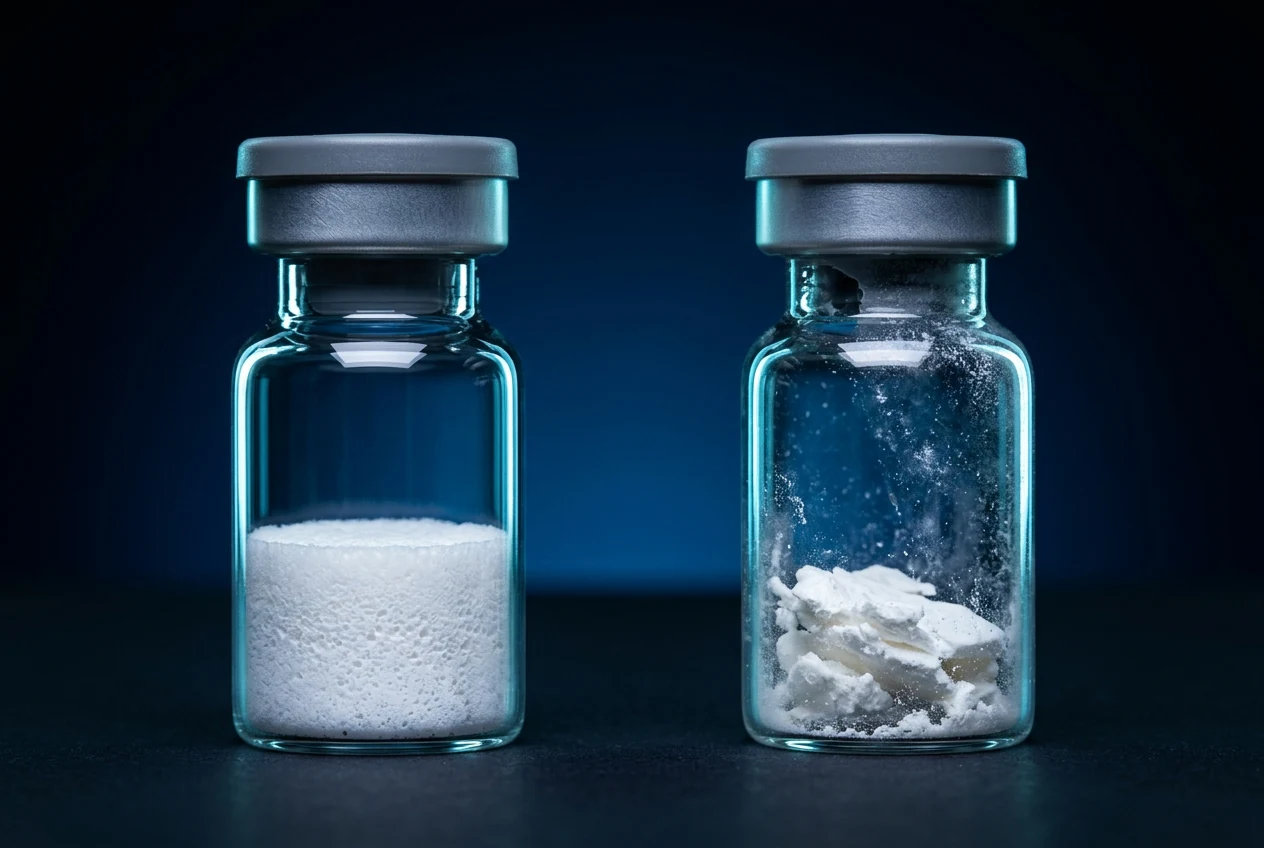
Collapsed cake, wrong color, loose seal, cloudy solution, no lot number. Fake peptide: how to tell by eye, and what only a lab can catch.
0.9% benzyl alcohol is the only thing separating bacteriostatic water for peptides from sterile water, and it decides how many days the vial lasts.
The "IU" on an insulin syringe measures volume, not mass. Peptide mg to IU conversion in two steps, plus the mix-up that costs a factor of 2.5.
Syringe size is not preference: it sets the smallest amount you can read. Below 30 units a 1 mL barrel adds error. How to pick the best syringe for peptides.
How to store peptides: lyophilized at 2–8 °C, reconstituted with the clock running. What destroys a peptide (heat, light, agitation, freezing) and the real margins.
Lipohypertrophy is documented in insulin therapy: tissue hardens and absorption turns erratic. Subcutaneous injection site rotation applies to any repeated shot.
TRIUMPH-1, 2, 3 and 4 have all reported. What each retatrutide phase 3 result measured, in which population, and what is still unpublished.
GIP spent years as the misunderstood incretin receptor. How does tirzepatide work, why dual agonism paid off, and what the SURMOUNT program shows.
In trials, most adverse events cluster during dose escalation, not maintenance. Why GLP-1 dose titration schedules exist at all.
GLP-1 side effects: nausea, constipation and reflux share one mechanism, slowed gastric emptying. The rates reported in the trials, dose by dose.
The scale doesn't separate fat from lean mass. What the literature says about GLP-1 muscle loss: how much lean mass a deficit costs and what changes it.
Metabolic adaptation, underreporting, fluid retention, sleep, NEAT. Why a weight loss plateau on GLP-1 is almost never the molecule that stalled.
Discontinuation trials are the uncomfortable data of the class. What they show about weight regain after stopping a GLP-1 and what has been studied to blunt it.
BPC-157, what does it do? Hundreds of rodent studies, zero published human trials. The category's best seller, and the one that holds up worst.
What is TB-500? A synthetic fragment, not thymosin β4. What that difference means, and what the ophthalmic trials (the family's only clinical data) show.
The best-selling BPC-157 TB-500 stack rests on a plausible mechanism and on zero studies of the combination. Both things are true at once.
Tendon vs muscle healing time differs because tendon has almost no blood supply. Each tissue's physiology explains why no molecule speeds up all four.
Three amino acids from the active end of α-MSH. What colitis models show about KPV peptide benefits, and why the PepT1 transporter is the unusual part.
Ipamorelin benefits are framed around selectivity: unlike other GHRPs, it barely raises cortisol or prolactin. What the secretion studies actually support.
CJC-1295 DAC vs no DAC: the Drug Affinity Complex stretches half-life from minutes to days. That changes the release pattern, and the pattern is what matters.
FDA-approved for HIV-associated lipodystrophy. What the trials measured, why tesamorelin visceral fat was the endpoint, and what cannot be extrapolated.
GHRP-6 hunger is not an unwanted side effect: it is the direct consequence of agonizing the ghrelin receptor, the body's hunger hormone.
What is IGF-1 LR3: the LR3 modification cuts binding-protein affinity and multiplies half-life. What that means systemically, and why it demands more caution.
A tetrapeptide with decades of Soviet research behind it and one serious problem: most studies of epithalon benefits fail today's methodological standards.
NAD+ falls with age and precursors do raise it again. The open question about NAD+ benefits is whether raising the marker changes anything.
Encoded in mitochondrial DNA, not nuclear. What "exercise mimetic" means, what the AMPK evidence shows about MOTS-c peptide benefits, and where it stops.
A modified ACTH fragment with no hormonal activity. What BDNF is, why it matters, and what evidence really backs semax nootropic benefits.
Selank for anxiety is pitched as a benzodiazepine without sedation or dependence. What backs that comparison, and why "without" is so hard to prove.
Semax vs Selank: same origin, same lab, same route, but not the same mechanism or goal. One pushes toward activation; the other toward calm.
Found while studying a form of absent puberty, kisspeptin sits one step above the entire axis. What research says about kisspeptin-10 benefits.
HCG for men works as an LH analog on Leydig cells. Why it is used when endogenous production is suppressed, and what it does not resolve.
PT-141 bremelanotide is FDA-approved for hypoactive sexual desire disorder in premenopausal women. It acts on melanocortin receptors in the brain, not blood flow.
PDE5 inhibitors act on blood flow; PT-141 acts on the brain's desire circuit. In the PT-141 vs Viagra question, they don't compete; they solve different problems.
GHK-Cu copper peptide benefits: a tripeptide that complexes with copper and is reported to modulate thousands of genes. What backs that claim and what doesn't.
GHK-Cu topical vs injection: decades of dermatologic evidence on one side, mostly preclinical data on the other. The difference is not convenience.
BPC-157, TB-500, and GHK-Cu in one vial. Each component has its own evidence; the glow peptide blend itself has never been studied in published work.
Melanotan II effects come from a non-selective melanocortin agonist. Why mole changes demand dermatology follow-up, and what the case reports actually show.
The WADA banned peptides list starts at S0, every unapproved substance, banned at all times, with no therapeutic exemption. What that means for athletes.
Preclinical, Phase 1, Phase 2, Phase 3, meta-analysis, anecdote. The hierarchy of levels of scientific evidence and the signs a study doesn't back its headline.
No article matches your search.