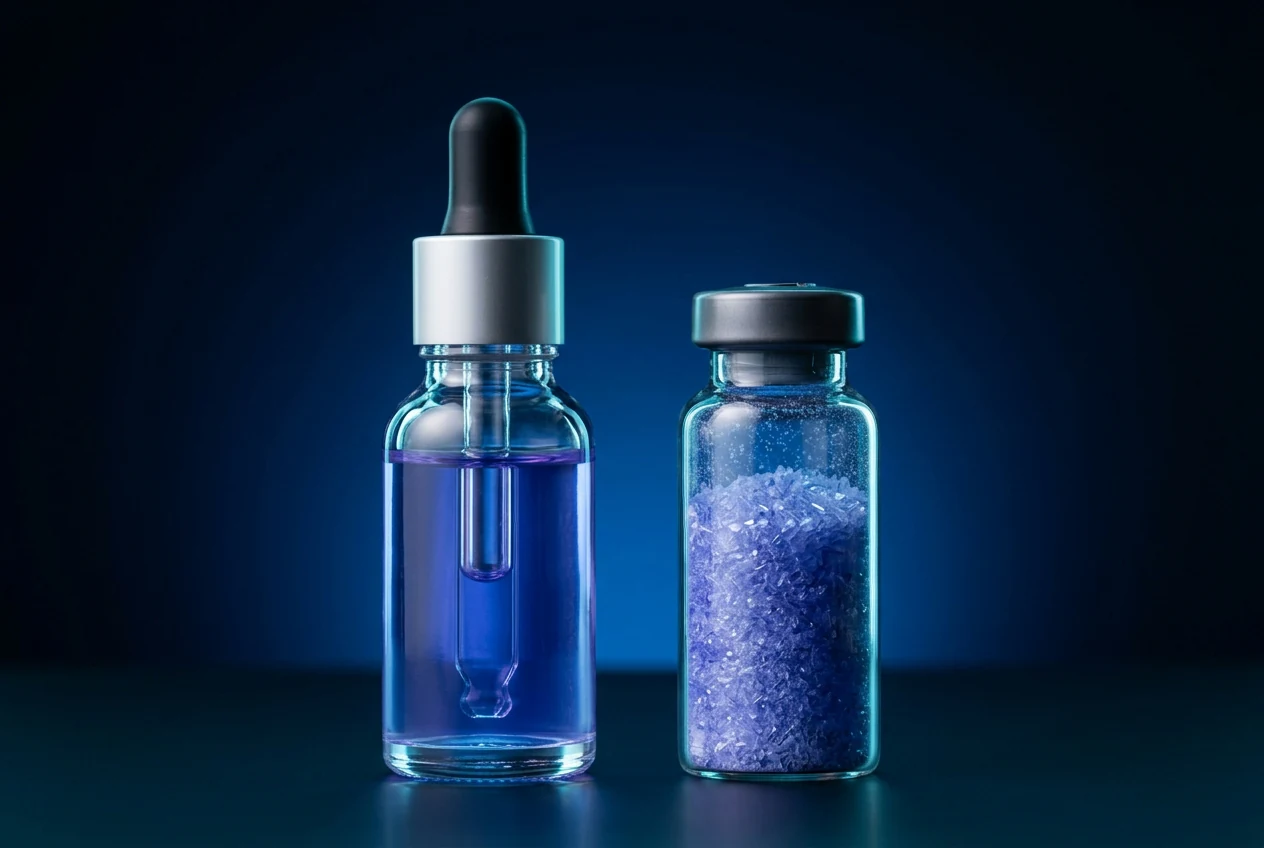
Topical GHK-Cu has decades of cosmetic use behind it, along with dermatologic studies that support effects on the skin. The injectable route has far less research. In the GHK-Cu topical vs injection comparison, the difference is not convenience: it is the amount and the quality of the evidence.
Skin penetration: what gets through and what does not
The skin's main barrier is the stratum corneum, a layer of dead keratinocytes in a lipid matrix that exists precisely to keep substances out.
What crosses it most easily: small molecules, relatively lipophilic, without charge.
GHK-Cu is small (three amino acids plus an ion) but charged, because of the copper. That combination makes its penetration limited and heavily dependent on the formulation.
And here is the observation that settles much of the debate: for the dermal effects described, deep penetration may not be the goal. If the relevant action happens on fibroblasts of the upper dermis and on the skin's extracellular matrix, reaching systemic circulation adds nothing to the outcome being sought.
What the dermatologic studies show
The topical evidence is the most consistent this compound has:
- Studies on collagen synthesis in dermal fibroblasts and in skin.
- Dermatologic clinical studies with outcomes measured in skin: firmness, density, appearance of fine lines.
- An established presence in cosmetic formulation, with decades of use and a characterized tolerability profile.
This is not drug clinical trial evidence, and it should not be oversold: these are dermatologic and cosmetic studies, with the limitations typical of that kind of research (moderate sample sizes, partly subjective outcomes).
Compared with the rest of the catalog, though, it is among the best available. The compound itself is covered in detail in its main article.
The systemic route: what is known and what is assumed
Much less, and the difference is worth stating plainly.
What is known: GHK is naturally present in human plasma, and its concentration falls with age. Preclinical studies describe systemic effects in animal models.
What is assumed: that the effects described in skin are reproduced in other tissues when the compound is given systemically.
That assumption has not been demonstrated. It is the usual extrapolation, from one tissue and one route to others, and in pharmacology it rarely holds without testing.
There is one further consideration specific to this route: systemic administration delivers copper to the circulation in amounts different from topical use, and cumulative exposure with repeated administration has not been characterized.
Concentrations and topical formulation
In cosmetic formulation, GHK-Cu appears at low concentrations. Three factors determine whether it does anything at all:
The vehicle. It largely determines how much crosses the stratum corneum. Two products with the same declared concentration can behave very differently.
The stability of the complex. pH and the presence of chelating agents can destabilize the copper-peptide bond. A product that has lost its copper has lost the active molecule, and the color gives it away.
Compatibility. The complex can interact with other ingredients in a cosmetic routine, particularly low-pH agents.
That last point explains why the blue color of a topical product is a useful check here as well: a GHK-Cu serum that has lost its hue has probably lost its active form.
When each route makes sense in research
| Topical | Systemic | |
|---|---|---|
| Evidence | Decades, with dermal outcomes | Scarce, mostly preclinical |
| Outcome studied | Skin: collagen, firmness, appearance | Extrapolated |
| Copper exposure | Very low | Not characterized with repeated use |
| Tolerability profile | Well known | Poorly documented |
For the GHK-Cu topical vs injection question, the table points to a direct conclusion: if the target is dermal, the topical route has better evidence, lower exposure, and a known tolerability profile. The systemic route is justified by hypothesis, not by data.
Batch analytical data for the research material are in its technical sheet. The case for the blend that includes it is in the article on Glow Blend.
What the evidence does not settle
- How much GHK-Cu actually penetrates with a given topical formulation: it depends on the vehicle and is rarely measured.
- Whether the dermal effects are reproduced systemically: not demonstrated.
- Systemic pharmacokinetics in humans: not published.
- Cumulative copper exposure by the systemic route: not characterized.
Frequently asked questions
Does the topical form reach the dermis?
Its penetration is limited and depends heavily on the formulation. For the dermal effects described, action on fibroblasts of the upper dermis may be enough: reaching the circulation is not the goal.
Why is there more topical evidence?
Because that is the route used for decades in cosmetics, with dermatologic studies that measure outcomes in skin. The systemic route has not accumulated a comparable body of work.
Is a serum that lost its blue color still useful?
Probably not. The color comes from the copper-peptide complex; losing it suggests the complex has been destabilized, and with it the active form described.
Does the injectable route give better results?
No evidence supports that. The rationale for the systemic route is an extrapolation from the dermal effects, not a finding.
References
- Pickart L, Margolina A. Regenerative and Protective Actions of the GHK-Cu Peptide in the Light of the New Gene Data. International Journal of Molecular Sciences, 2018;19(7):1987. DOI: 10.3390/ijms19071987
- Maquart FX, et al. Stimulation of collagen synthesis in fibroblast cultures by the tripeptide-copper complex. FEBS Letters, 1988;238(2):343–346. DOI: 10.1016/0014-5793(88)80511-580511-5)
- Bos JD, Meinardi MM. The 500 Dalton rule for the skin penetration of chemical compounds and drugs. Experimental Dermatology, 2000;9(3):165–169. DOI: 10.1034/j.1600-0625.2000.009003165.x
- Finkey MB, et al. Copper peptide and skin. Cosmeceuticals and Active Cosmetics, 2005. Editorial reference
Written by the Bionic Editorial Team. Last reviewed: September 2026.
How we work: our editorial policy and source hierarchy.
This content is strictly educational and does not constitute medical advice, diagnosis or a therapeutic recommendation. The compounds mentioned are research products (Research Use Only) and are not approved by INVIMA, FDA, EMA or ANSM for therapeutic use in humans. Any health-related decision should be made with a licensed medical professional.