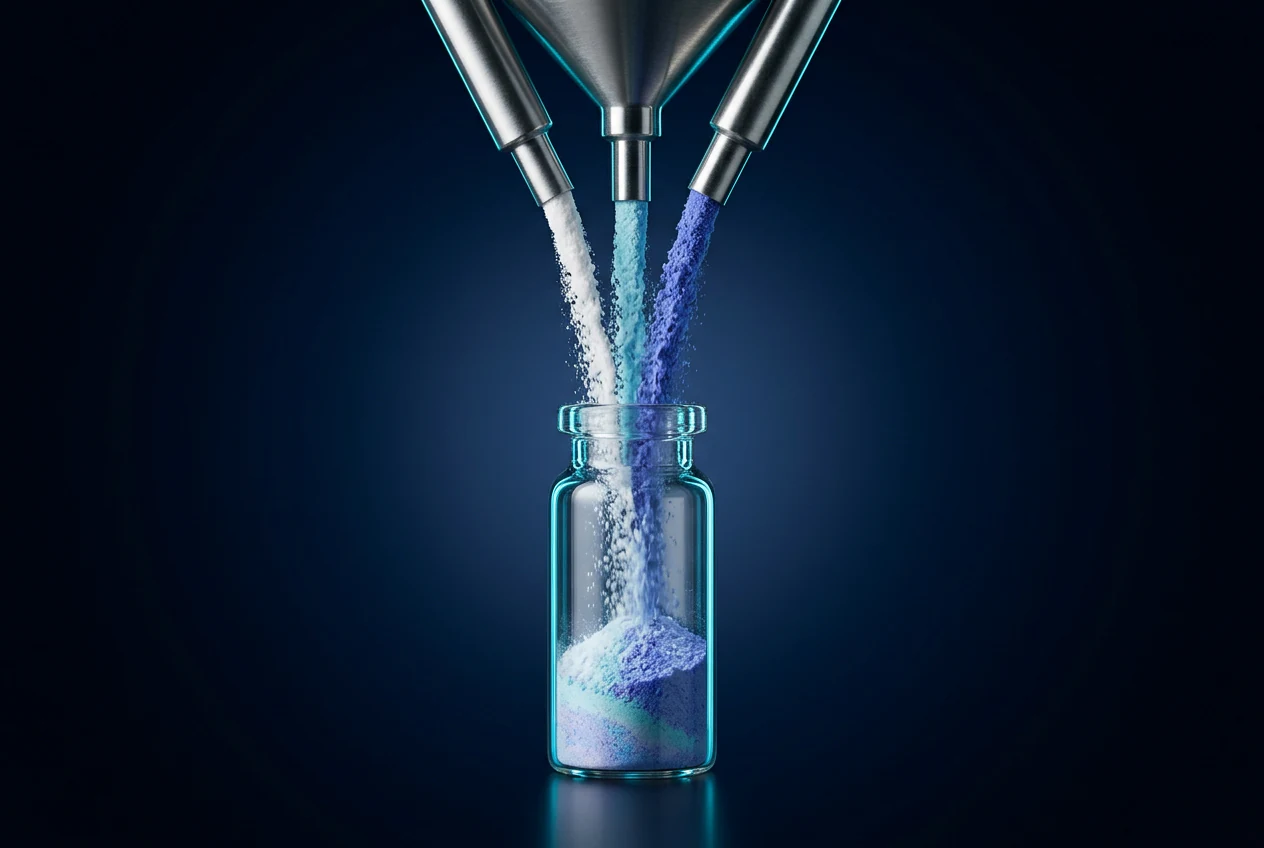
Glow Blend puts BPC-157, TB-500, and GHK-Cu into a single vial. All three carry preclinical evidence of their own, each covering a different phase of repair. The glow peptide blend as a mixture has never been studied in any published work.
The three components and the phase each one covers
| Component | Proposed phase | Described mechanism | Evidence of its own |
|---|---|---|---|
| BPC-157 | Proliferation | Angiogenesis via VEGFR2, cell migration | Extensive preclinical work; limited independent replication |
| TB-500 | Proliferation and migration | G-actin binding | Preclinical; ophthalmic clinical trials with the full molecule |
| GHK-Cu | Remodeling and matrix | Collagen synthesis, copper cofactor | Decades of dermatology literature |
What the table shows: the three act on different moments of the process described in the pillar article on tissue repair. They do not overlap.
The complementarity hypothesis
The argument for the blend is that it covers the whole sequence:
- BPC-157 promotes vessel formation and brings cells to the area.
- TB-500 favors the cell motility that lets those cells move.
- GHK-Cu acts in the matrix phase, and it also supplies the copper cofactor that lysyl oxidase needs to cross-link collagen.
The reasoning is coherent. The three mechanisms are distinct, they act at different moments, and they do not compete for the same receptor.
What it is not is a finding.
Where the ratios actually come from
This deserves to be said plainly, exactly as in the two-component combination.
The ratios that circulate as standard do not come from any study. No published literature has compared ratios against one another or identified an optimal one for any application.
They settled in by market convention, popularized by industry players with a commercial interest in selling them, and they hold up through repetition.
A ratio appearing in a hundred catalogs does not make it evidence. It makes it a convention, and a convention can be reasonable or arbitrary, but it is not data.
Stability considerations when three compounds share a vial
Combining three molecules in one vial raises technical questions that do not exist when they are kept apart:
Joint stability. There are no published stability studies of this mixture. Three compounds that are stable on their own are not necessarily stable together, or stable for the same length of time.
The copper complex. GHK-Cu is the most delicate of the three on this point: its active form depends on the copper-peptide complex staying intact. Solution pH and the presence of other compounds can destabilize it. If the complex breaks, the component loses its active form, and as explained in its own article, the color gives it away.
Analytical traceability. A certificate for a blend has to document identity, purity, and content for each component separately. A single aggregate value tells you nothing about the real ratio inside the vial. How to check that is covered in the article on certificates.
The shared blind spot: angiogenesis
All three components share pro-angiogenic properties, to different degrees. That is the mechanism that makes the combination attractive, and it is also the one that forces us to repeat the pillar article's warning here:
Angiogenesis is not selective. A mechanism that promotes the formation of new vessels does not distinguish between injured tissue and another kind of tissue that also depends on blood supply to grow. That turns these properties into a theoretical concern in the presence of a known or suspected neoplasm, including an undiagnosed one.
Combining three compounds that share that mechanism does not reduce the consideration; it concentrates it. That is why any decision in such a context belongs exclusively to a medical professional.
This is not a claim that these compounds cause cancer (no data support that). It is a consideration that follows from the very mechanism their advocates propose.
How to assess a blend with no blend data
The same four-question filter that applies to any combination:
- Does each component have evidence on its own? Here: preclinical for all three, of uneven quality. The strongest is topical GHK-Cu.
- Is the complementarity hypothesis coherent? Yes, and that is worth acknowledging.
- Is there any study of the mixture? No.
- Do the ratios have an empirical origin? No.
Two out of four, and the two that fail are the ones that would matter for a decision.
Batch analytical data is on its technical sheet.
What the evidence does not settle
- Whether the blend adds anything over its isolated components: no studies.
- What ratio would be appropriate for anything specific: no empirical basis.
- Joint stability and the behavior of the copper complex inside the mixture: no published studies.
- Safety: there is no human data for any of the three separately, let alone for the combination.
Frequently asked questions
Is the blend better than the components on their own?
Nobody knows. No study compares the mixture against its isolated components, which is the only design that could answer the question.
Where do the ratios come from?
From market convention, not from comparative studies. No literature has identified an optimal ratio.
Can the copper affect the other two components?
It is a legitimate technical question, and an unresolved one: no stability studies of this mixture have been published. The active form of GHK-Cu depends on the copper-peptide complex staying intact.
Why so much emphasis on angiogenesis?
Because it is the mechanism all three share and the one that makes the combination attractive. That it is not selective is a theoretical consideration following directly from that mechanism, and combining three compounds that share it concentrates the consideration rather than diluting it.
References
- Pickart L, Margolina A. Regenerative and Protective Actions of the GHK-Cu Peptide in the Light of the New Gene Data. International Journal of Molecular Sciences, 2018;19(7):1987. DOI: 10.3390/ijms19071987
- Goldstein AL, et al. Thymosin β4: actin-sequestering protein moonlights to repair injured tissues. Trends in Molecular Medicine, 2005;11(9):421–429. DOI: 10.1016/j.molmed.2005.07.004
- Hsieh MJ, et al. Therapeutic potential of pro-angiogenic BPC157 is associated with VEGFR2 activation and up-regulation. Journal of Molecular Medicine, 2017;95(3):323–333. DOI: 10.1007/s00109-016-1488-y
- Carmeliet P, Jain RK. Molecular mechanisms and clinical applications of angiogenesis. Nature, 2011;473:298–307. DOI: 10.1038/nature10144
Written by the Bionic Editorial Team. Last reviewed: September 2026.
How we work: our editorial policy and source hierarchy.
This content is strictly educational and does not constitute medical advice, diagnosis or a therapeutic recommendation. The compounds mentioned are research products (Research Use Only) and are not approved by INVIMA, FDA, EMA or ANSM for therapeutic use in humans. Any health-related decision should be made with a licensed medical professional.