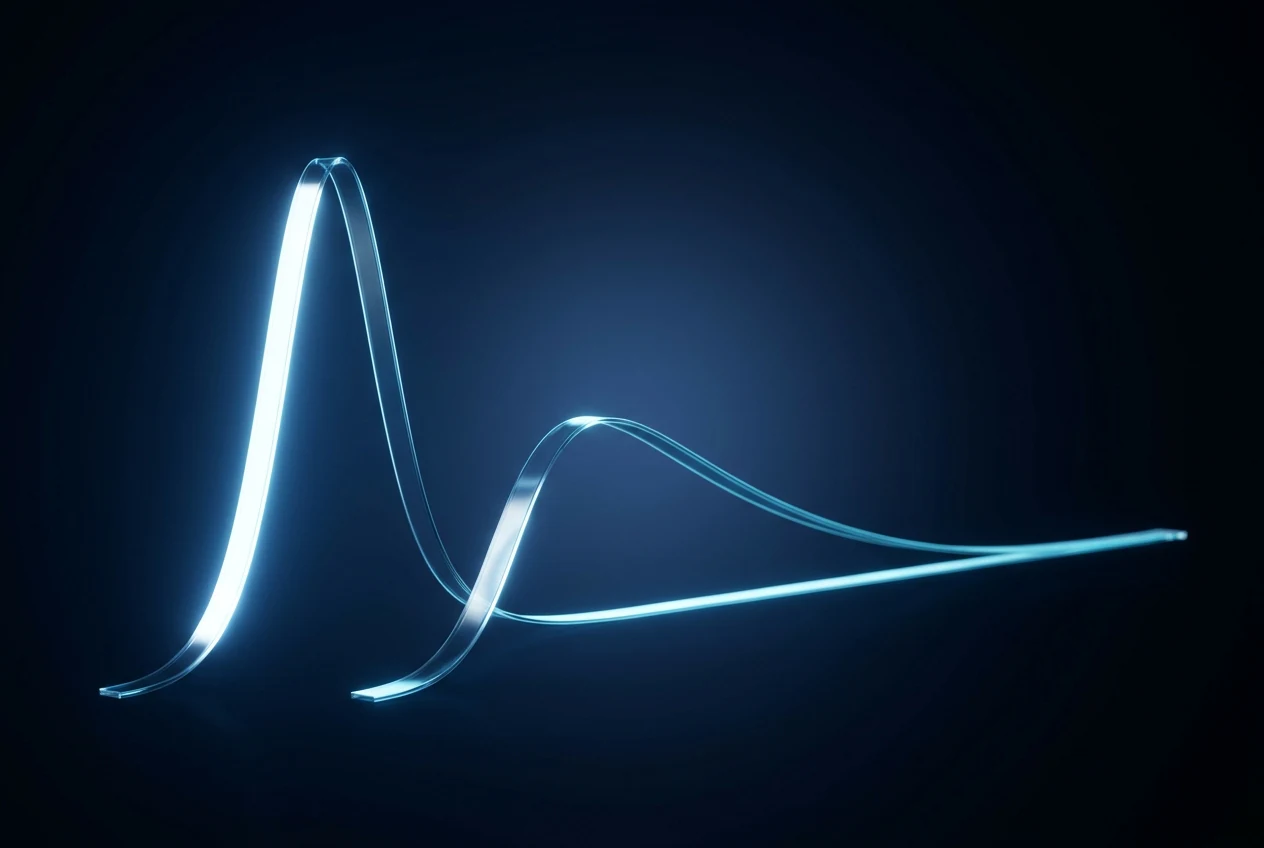
CJC-1295 DAC vs no DAC is not one compound sold in two lengths. The Drug Affinity Complex binds the molecule to serum albumin and stretches its half-life from minutes to several days. Without DAC, growth hormone release mimics the physiological pulsatile pattern. With DAC, it produces a sustained elevation. These are not the same strategy at two durations. They are two different things.
What DAC is and how it works
DAC is a chemical group, a maleimidopropionyl-lysine chain, added to the molecule. Its job is to bind covalently to serum albumin, the most abundant protein in plasma.
Albumin has a half-life of roughly twenty days. Traveling attached to it, the molecule is shielded from enzymatic degradation and from renal filtration, and it inherits part of that persistence.
This is the same design strategy used by several approved drugs in other classes: bind albumin, and a molecule that lasted minutes now lasts days.
Half-life: minutes versus days
| Version | Approximate half-life | Resulting pattern |
|---|---|---|
| CJC-1295 no DAC | On the order of minutes | Short, defined pulse |
| CJC-1295 with DAC | On the order of days | Sustained elevation |
The gap spans three orders of magnitude, and it does not deliver "the same thing for longer." It delivers a qualitatively different exposure profile.
Pulsatile versus sustained: why the pattern matters
This is the heart of CJC-1295 DAC vs no DAC, and it connects with the pillar on the GH axis.
Growth hormone is secreted in pulses: concentrated peaks, mostly during deep sleep, separated by troughs where levels drop very low.
That alternation is not an accident of the system. Receptors respond to the pattern, not only to cumulative exposure. And the troughs do a job: they let receptors resensitize.
Two consequences follow.
Without DAC produces a short pulse that adds to the physiological pattern, followed by a trough.
With DAC produces an elevation held for days. There is no trough. Total exposure is higher, and the pattern is different from the physiological one.
Which of the two profiles is preferable is not settled by clinical evidence. What is established is that they are different, and that in endocrine physiology the pattern of a signal is information, not just its magnitude.
Consequences for feedback in the axis
A sustained elevation has a predictable effect on the control loop: it keeps negative feedback switched on. GH and IGF-1 held high raise somatostatin tone, which is the brake on the system.
The expected result is progressive attenuation of the response: the same signal produces less and less secretion, because the system is compensating.
With a pulsatile profile, the trough between pulses lets that tone fall. That is the physiological reason the version without DAC is described as gentler on the axis. It is sound mechanistic reasoning; it is not a clinical trial confirming it.
Which version is in the catalog, and why
The catalog carries CJC-1295 without DAC. The reason is the one above: it produces a short pulse that approximates the physiological pattern, instead of a sustained elevation that keeps the brake permanently engaged.
Its analytical data are on its product page.
One point of terminology is worth making, because it causes constant confusion: the version without DAC is also called modified GRF (1-29), or simply CJC-1295 no DAC. When a source writes "CJC-1295" with no further detail, there is no way to know which of the two it means, and the two molecules have very different profiles.
Sermorelin, tesamorelin and CJC: the three GHRH cousins
| Compound | What it is | Half-life | Approval |
|---|---|---|---|
| Sermorelin | Unmodified GHRH fragment 1-29 | Very short | Was approved; withdrawn from the market as a commercial decision |
| CJC-1295 no DAC | 1-29 with substitutions that resist degradation | Minutes | No |
| CJC-1295 with DAC | The above plus albumin binding | Days | No |
| Tesamorelin | A different stabilized analog | Intermediate | Yes, FDA, for one specific indication |
All four act on the same receptor. What separates them is how long they last and, in one case, whether anyone completed the regulatory file. The detail on tesamorelin is in its own article.
And a practical consequence: combining two GHRH analogs adds nothing, because they compete for the same receptor.
What the evidence does not settle
Which of the two profiles produces better clinical outcomes. No trials compare them against functional endpoints.
How much desensitization sustained exposure produces, and whether it reverses on discontinuation.
Detailed human pharmacokinetics for either version, published independently.
Medium-term safety. No studies.
Frequently asked questions
What does DAC stand for?
Drug Affinity Complex: a chemical group that binds the molecule to serum albumin, shielding it from degradation and extending its half-life from minutes to days.
Which one is better?
CJC-1295 DAC vs no DAC is not settled by clinical evidence. The argument for the version without DAC is physiological: it respects the pulsatile pattern and lets negative feedback relax between pulses. That is mechanistic reasoning, not a trial result.
Why is the pattern said to matter?
Because receptors respond to the time profile of the signal, not only to cumulative exposure. A constant level desensitizes differently than the same exposure split into pulses.
If a label says only "CJC-1295," what is it?
There is no way to know without more information. The two versions have very different profiles, and the label should specify whether it carries DAC.
References
- Teichman SL, et al. Prolonged stimulation of growth hormone (GH) and insulin-like growth factor I secretion by CJC-1295, a long-acting analog of GH-releasing hormone, in healthy adults. Journal of Clinical Endocrinology & Metabolism, 2006;91(3):799–805. DOI: 10.1210/jc.2005-1536
- Ionescu M, Frohman LA. Pulsatile secretion of growth hormone (GH) persists during continuous stimulation by CJC-1295, a long-acting GH-releasing hormone analog. Journal of Clinical Endocrinology & Metabolism, 2006;91(12):4792–4797. DOI: 10.1210/jc.2006-1702
- Le Roith D, Bondy C, Yakar S, Liu JL, Butler A. The Somatomedin Hypothesis: 2001. Endocrine Reviews, 2001;22(1):53–74. DOI: 10.1210/edrv.22.1.0419
- Müller EE, et al. Neuroendocrine control of growth hormone secretion. Physiological Reviews, 1999;79(2):511–607. DOI: 10.1152/physrev.1999.79.2.511
Written by the Bionic Editorial Team. Last reviewed: September 2026.
How we work: our editorial policy and source hierarchy.
This content is strictly educational and does not constitute medical advice, diagnosis or a therapeutic recommendation. The compounds mentioned are research products (Research Use Only) and are not approved by INVIMA, FDA, EMA or ANSM for therapeutic use in humans. Any health-related decision should be made with a licensed medical professional.