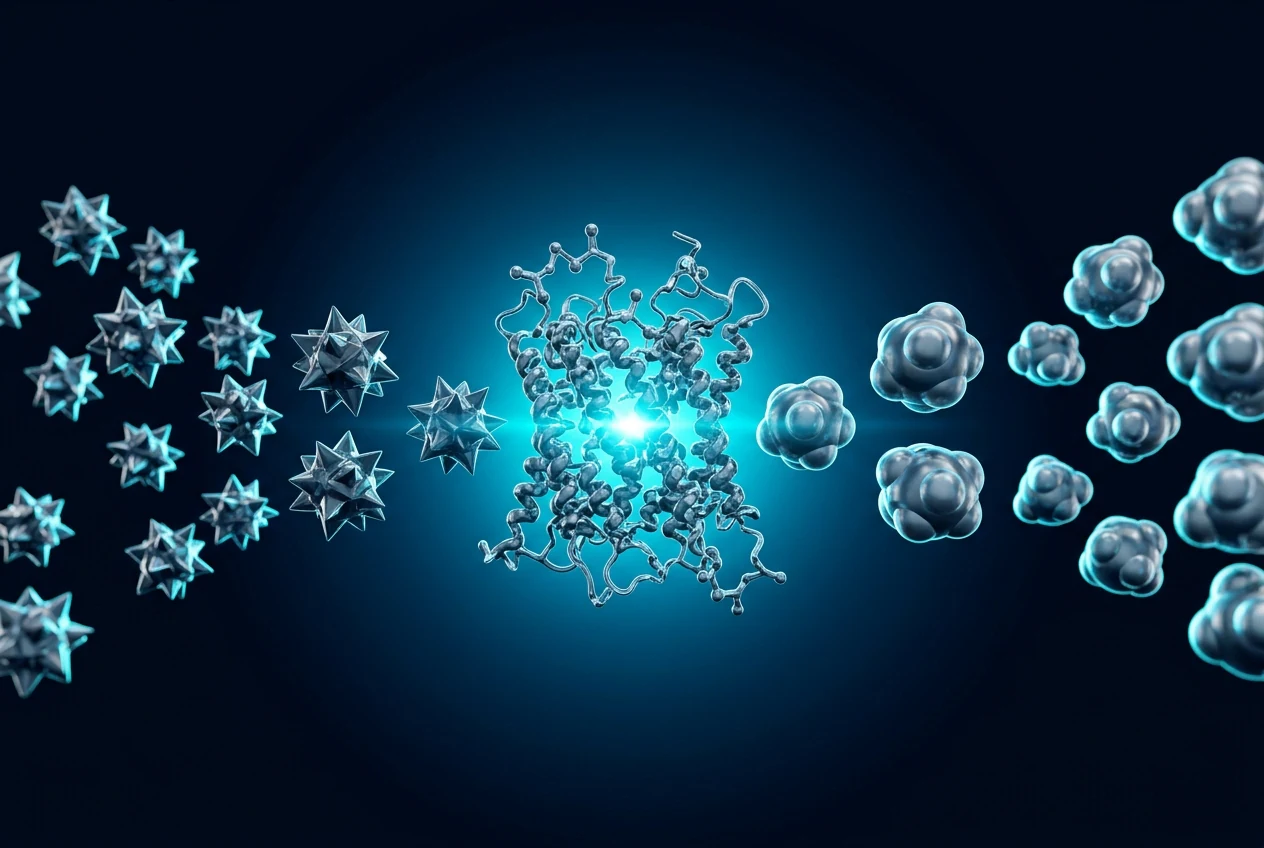
Growth hormone secretagogues explained in one line: two families, two receptors. GHRH analogs push the pituitary to release growth hormone; ghrelin receptor agonists push it too, and also lift the brake. Acting on both pathways at once produces a larger response than either pathway produces alone.
How the GH-IGF-1 axis works
Three levels, plus a control loop.
The hypothalamus sends two opposing signals: GHRH, which orders growth hormone release, and somatostatin, which blocks it. What gets secreted depends on the balance between them.
The pituitary responds by releasing GH in pulses, not continuously. That detail is central, and it gets its own section below.
The liver and peripheral tissues respond to GH by producing IGF-1, which mediates much of what is attributed to growth hormone itself.
Closing the circuit is a negative feedback loop: elevated GH and elevated IGF-1 both raise somatostatin and slow production down. The system is built to return to equilibrium, and that design is exactly what limits any attempt to force it in a sustained way.
The GHRH family: what it does and who belongs to it
GHRH analogs mimic the hypothalamic signal and bind the GHRH receptor in the pituitary. The result is a direct push on release.
The members that come up most often:
| Compound | Distinguishing feature |
|---|---|
| Sermorelin | Fragment 1-29 of GHRH; very short half-life |
| CJC-1295 without DAC | Modified to resist degradation; half-life of minutes |
| CJC-1295 with DAC | Albumin-bound; half-life of days |
| Tesamorelin | Stabilized analog; the only one with regulatory approval |
Their limit is structural: a GHRH analog presses the accelerator, but it does not release the brake. Somatostatin keeps working, and when its tone is high the response to GHRH is blunted.
The GHRP family: the ghrelin receptor and somatostatin
GHRPs (growth hormone releasing peptides) act on a completely different receptor: the GH secretagogue receptor, the same one ghrelin activates, the hunger hormone.
They do two things at once:
- They stimulate GH release directly, through a pathway of their own.
- They lower somatostatin tone, which is to say, they lift the brake.
The usual members: ipamorelin, GHRP-2, GHRP-6 and hexarelin, with different selectivity profiles that determine what else they do besides the intended effect.
Why the synergy is real and not marketing
This part deserves a pause, because it is one of the few claims in this sector that does have a physiological basis.
A GHRH accelerates. A GHRP accelerates and takes the brake off. Combining them acts on three points of the system instead of one:
- Stimulation through the GHRH pathway.
- Stimulation through the ghrelin receptor pathway.
- Reduced somatostatinergic tone, which amplifies both of the above.
The endocrine physiology literature describes secretory responses to combined administration that exceed those of each agent given separately. This is not a commercial argument: it is an observation reproduced in studies of pituitary secretion.
That said, two qualifiers the sector leaves out. The synergy is documented on the size of the secretory pulse, and a pulse is a marker; whether it translates into clinical results over the medium term is a separate question, and it is the distinction between marker and outcome. Also, the response is blunted with repeated use, through the axis's own negative feedback.
Each compound and its family
| Compound | Family | Feature | Consideration |
|---|---|---|---|
| Ipamorelin | GHRP | The most selective | Minimal effect on cortisol and prolactin |
| GHRP-6 | GHRP | Marked appetite stimulus | Via the ghrelin receptor |
| CJC-1295 without DAC | GHRH | Short pulse | Respects the physiological pattern |
| Tesamorelin | GHRH | FDA approved | For one specific indication and one specific population |
| IGF-1 LR3 | Not a secretagogue | Acts downstream of the axis | Different risk profile |
That last row matters: IGF-1 LR3 does not belong to this category. It does not stimulate GH production; it substitutes for the final mediator, bypassing the axis and its feedback control. That changes its profile completely, and it has an article of its own. Any account of growth hormone secretagogues explained without that distinction is incomplete.
When combining adds nothing
The GHRH plus GHRP synergy is real. What is not:
Combining two GHRPs. They compete for the same receptor. Adding a second agonist for the same lock does not multiply the effect; at best it saturates it.
Combining two GHRHs. Same problem in the other family. This is specifically relevant with tesamorelin, where adding another GHRH is redundant.
More of the same agent. The pituitary response has a ceiling: the amount of GH stored and available for release is finite. Past that point, more stimulus does not produce more secretion.
Pulsatility: why the pattern matters as much as the amount
This is the concept that separates understanding the axis from repeating slogans.
GH is not secreted continuously but in pulses, concentrated above all during deep sleep. Between pulses, levels drop to very low values.
That alternation is not a flaw in the system: it is information. GH receptors in tissues respond to the pattern, not only to the average concentration. A high, constant level produces different effects, desensitization among them, compared with the same total exposure spread across pulses.
Two practical consequences follow.
A long half-life molecule produces sustained levels, not pulses. That is the central difference between the two versions of CJC-1295, and it is covered in the article comparing them.
A sustained level activates negative feedback continuously, raising somatostatin tone and blunting the body's own response.
What the evidence does not settle
Prolonged use is poorly characterized. The acute physiology of the axis is well described; what happens under repeated stimulation over months or years, much less so.
The outcomes are markers. Most studies measure GH and IGF-1 concentrations. What translates into meaningful functional change is a different question.
Individual response varies widely and depends on age, body composition, sleep and baseline somatostatinergic tone. There is no validated predictor.
Apart from tesamorelin, none has approval for human therapeutic use, and for athletes under anti-doping rules all of them fall under section S2 of the prohibited list.
Frequently asked questions
Is a secretagogue the same thing as growth hormone?
No. Exogenous GH supplies the hormone directly. A secretagogue prompts the body to release its own, which preserves the pulsatile pattern and keeps the axis feedback intact.
Why combine a GHRH with a GHRP?
Because they act on different receptors, and the GHRP also lowers somatostatin tone. The synergy is documented in endocrine physiology; it is not a marketing construct.
Can two GHRPs be combined?
It adds nothing: they compete for the same receptor. The same applies to combining two GHRHs with each other.
Why are they given at night?
Because the main physiological GH pulse occurs during deep sleep, and dosing in that window lines up with the natural pattern instead of competing with it.
References
- Bowers CY. Growth hormone-releasing peptide (GHRP). Cellular and Molecular Life Sciences, 1998;54(12):1316–1329. DOI: 10.1007/s000180050257
- Kojima M, et al. Ghrelin is a growth-hormone-releasing acylated peptide from stomach. Nature, 1999;402:656–660. DOI: 10.1038/45230
- Le Roith D, Bondy C, Yakar S, Liu JL, Butler A. The Somatomedin Hypothesis: 2001. Endocrine Reviews, 2001;22(1):53–74. DOI: 10.1210/edrv.22.1.0419
- Müller EE, et al. Neuroendocrine control of growth hormone secretion. Physiological Reviews, 1999;79(2):511–607. DOI: 10.1152/physrev.1999.79.2.511
- World Anti-Doping Agency. The Prohibited List, section S2. wada-ama.org
Written by the Bionic Editorial Team. Last reviewed: September 2026.
How we work: our editorial policy and source hierarchy.
This content is strictly educational and does not constitute medical advice, diagnosis or a therapeutic recommendation. The compounds mentioned are research products (Research Use Only) and are not approved by INVIMA, FDA, EMA or ANSM for therapeutic use in humans. Any health-related decision should be made with a licensed medical professional.