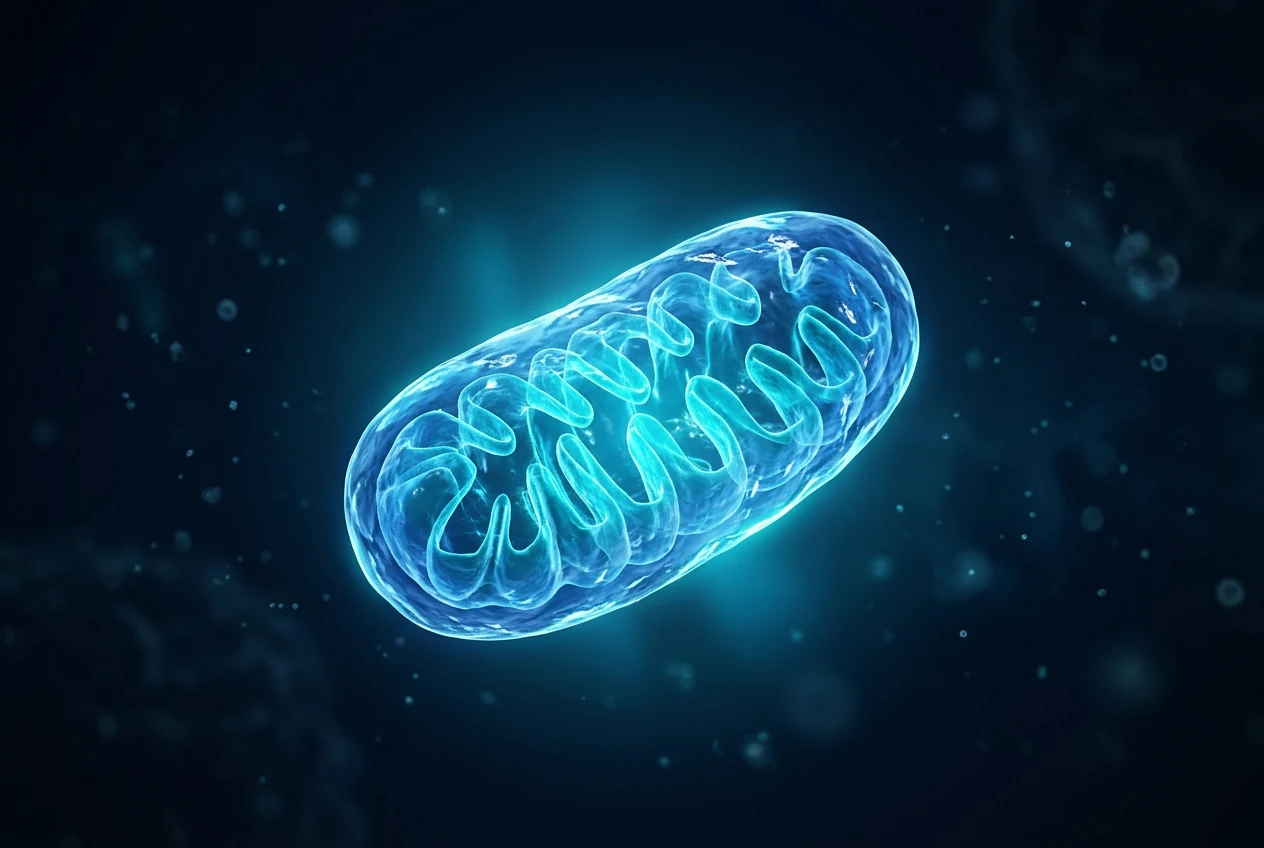
MOTS-c is a 16-amino-acid peptide encoded in the mitochondrial genome, not the nuclear one. It acts on the AMPK pathway and on glucose metabolism, which is what earned it the "exercise mimetic" label. Any serious account of MOTS-c peptide benefits starts there, and with the caveat that the label describes a shared pathway, not a substitute.
A gene inside the mitochondrion
Mitochondria carry their own DNA, a remnant of their origin as bacteria absorbed into eukaryotic cells. That genome is small, and most of what it encodes are components of the respiratory chain.
What came to light a little over a decade ago is that it also encodes peptides that signal outside the mitochondrion. They were named mitochondrial-derived peptides, and MOTS-c is the best studied of them.
The conceptual implication is striking. The mitochondrion is not only the cell's power plant. It sends signals that act on the nucleus and on other tissues. This is communication running from the organelle out to the organism.
AMPK: the cell's energy sensor
AMPK, AMP-activated protein kinase, is the cell's energy-state sensor. It switches on when the AMP/ATP ratio rises, that is, when energy runs short.
Once active, it steers metabolism toward making energy rather than spending it. Glucose uptake goes up, fatty acid oxidation goes up, mitochondrial biogenesis goes up, and costly anabolic processes are put on hold.
This is the pathway that exercise activates, along with caloric restriction and some metabolic drugs. MOTS-c is described as an activator of that same pathway.
What "exercise mimetic" does and does not mean
This is the most important section of the article, which is why it sits in the middle.
What the label gets right: MOTS-c activates AMPK, one of the pathways exercise also activates. The mechanistic overlap is real.
What the label does not mean, stated plainly:
Exercise is not a signaling pathway. It is a very broad set of simultaneous stimuli: mechanical load on bone, tendon and muscle; cardiovascular adaptation; neuromuscular response; effects on the immune system, on sleep, on mood, on insulin sensitivity through multiple routes, on capillary density.
Activating one of those pathways pharmacologically does not reproduce the whole. A compound that activates AMPK does not put mechanical load on a tendon, does not improve coordination, and does not produce the cardiovascular adaptations of training.
"Exercise mimetic" is a laboratory label for pathway overlap. Reading it as "equivalent to training" is a leap that neither the biology nor any study supports.
Insulin sensitivity in preclinical models
The metabolic line of research is the one with the most ground behind it, and it is where most claims about MOTS-c peptide benefits come from. In animal models, MOTS-c administration has been described in association with:
- Improvement in insulin sensitivity parameters.
- Resistance to diet-induced obesity.
- Changes in skeletal muscle metabolism.
The limits are the usual ones at this level of evidence: rodents, induced models, marker endpoints rather than functional ones.
| Stimulus | Activates AMPK | Mechanical load | Cardiovascular adaptation | Neuromuscular response |
|---|---|---|---|---|
| Exercise | Yes | Yes | Yes | Yes |
| MOTS-c | Yes (described) | No | No | No |
That table is the entire argument against reading "exercise mimetic" as "substitute."
The decline with age and the population data
Circulating MOTS-c levels fall with age, and population studies have described associations between those levels and certain metabolic parameters.
One finding cited often links a specific genetic variant of the MOTS-c gene to longevity in one particular population. It is an interesting data point, and it should be read precisely: a genetic association in a population does not demonstrate that administering the peptide produces the same effect. Those are two very different claims.
The decline with age also raises the same open question as NAD+: cause or consequence. The association is documented. The direction of causality is not.
What is missing: controlled human trials
The list is the one that applies to the whole field:
- No randomized controlled trials in any indication.
- No published human pharmacokinetics.
- No established dose for people.
- No safety data over any time frame.
- No functional endpoints measured in humans.
Batch analytical data is on its technical sheet, and the general framework for the cluster is in the longevity pillar.
What the evidence does not settle
Beyond the absence of trials, two conceptual questions remain open.
Whether exogenous administration reproduces endogenous signaling. A peptide produced by the mitochondrion in response to energy stress, released in a specific context, is not necessarily equivalent to the same molecule given from outside in a different one.
Whether sustained AMPK activation is desirable. AMPK is a sensor; its job is to respond to a state. Switching it on continuously, regardless of the actual state, is not obviously the same as switching it on when the state calls for it.
Frequently asked questions
Does MOTS-c replace exercise?
No. It activates one of the pathways exercise also activates. Exercise additionally produces mechanical load, cardiovascular adaptation, neuromuscular response and many other effects that no single pathway reproduces.
Why does it matter that it is encoded in the mitochondria?
Because it means the mitochondrial genome does not only produce parts of the energy machinery, it also produces signals that act outside the organelle. That is a relatively recent concept in cell biology.
Are there human studies?
There are observational studies describing circulating levels and their associations. There are no controlled trials of administration.
Does the decline with age mean it should be replaced?
That conclusion does not follow. The decline is documented; whether it is a cause of aging or a consequence of it is an open question, and whether replacing it makes sense depends on the answer.
References
- Lee C, et al. The mitochondrial-derived peptide MOTS-c promotes metabolic homeostasis and reduces obesity and insulin resistance. Cell Metabolism, 2015;21(3):443–454. DOI: 10.1016/j.cmet.2015.02.009
- Kim KH, et al. Mitochondrially derived peptides as novel regulators of metabolism. Journal of Physiology, 2017;595(21):6613–6621. DOI: 10.1113/JP274472
- Fuku N, et al. The mitochondrial-derived peptide MOTS-c: a player in exceptional longevity? Aging Cell, 2015;14(6):921–923. DOI: 10.1111/acel.12389
- Reynolds JC, et al. MOTS-c is an exercise-induced mitochondrial-encoded regulator of age-dependent physical decline and muscle homeostasis. Nature Communications, 2021;12:470. DOI: 10.1038/s41467-020-20790-0
- Hardie DG, et al. AMPK: a nutrient and energy sensor that maintains energy homeostasis. Nature Reviews Molecular Cell Biology, 2012;13:251–262. DOI: 10.1038/nrm3311
Written by the Bionic Editorial Team. Last reviewed: August 2026.
How we work: our editorial policy and source hierarchy.
This content is strictly educational and does not constitute medical advice, diagnosis or a therapeutic recommendation. The compounds mentioned are research products (Research Use Only) and are not approved by INVIMA, FDA, EMA or ANSM for therapeutic use in humans. Any health-related decision should be made with a licensed medical professional.