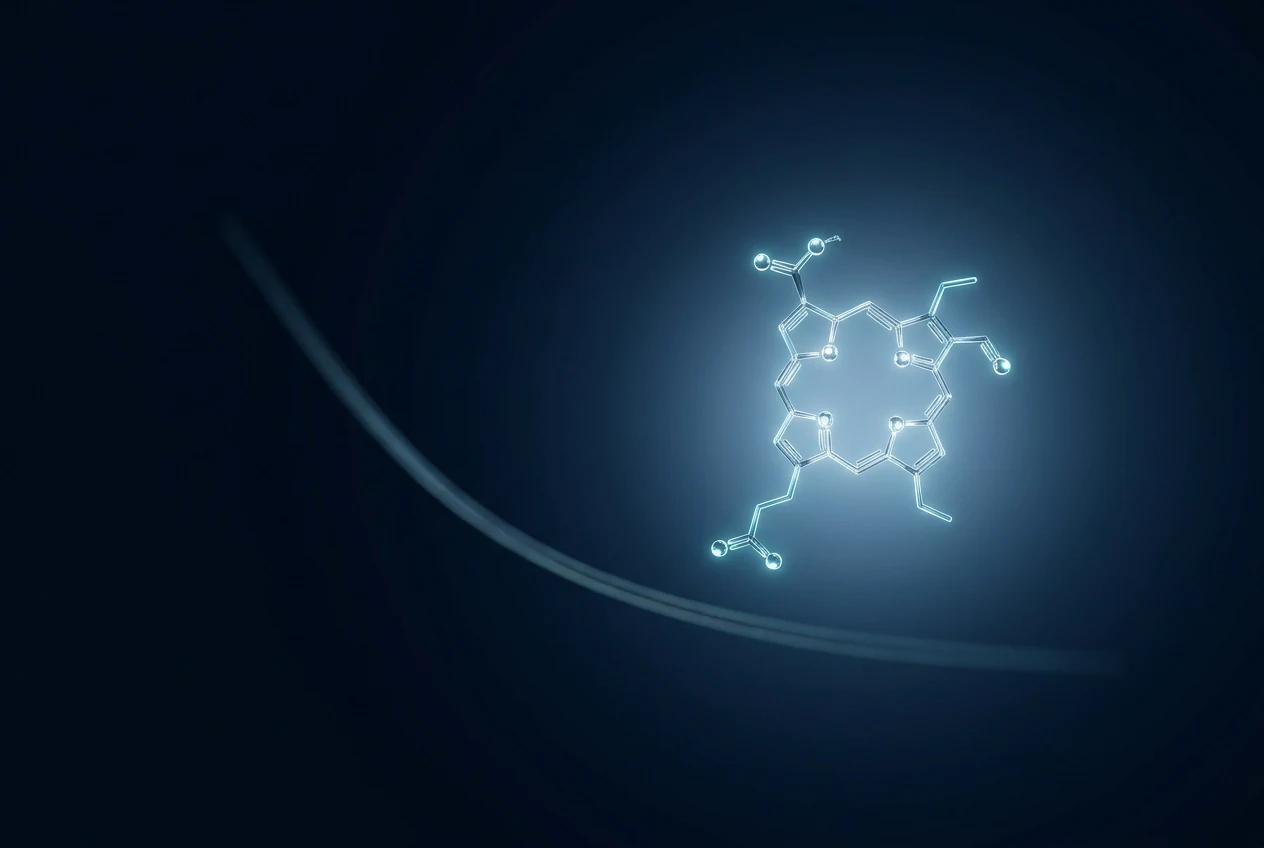
NAD+ is an essential cofactor for energy metabolism, DNA repair, and sirtuin activation, and its levels fall with age. The decline itself is well documented. What the evidence has not settled is the question behind every claim about NAD+ benefits: whether putting it back produces any clinical benefit.
What NAD+ does in the cell
Nicotinamide adenine dinucleotide is one of the most ubiquitous cofactors in cell biochemistry. It has three main jobs:
Electron transport. It is the central electron acceptor of energy metabolism: glycolysis, the Krebs cycle, and the respiratory chain all depend on the NAD+/NADH pair.
Substrate for the PARPs. Poly-ADP-ribose polymerases, the DNA repair enzymes, consume NAD+ as they work. They do not use it as a catalyst; they spend it.
Substrate for the sirtuins. This family of enzymes, involved in metabolic regulation and in several pathways associated with aging, also consumes NAD+ in order to function.
The last two explain why the NAD+ level matters: it is a limited resource that different processes compete for.
Why it declines: consumption by PARP and CD38
The age-related fall in NAD+ is documented in tissues from several species. The explanations the literature works with are not about lower production but about higher consumption:
Increased PARP activity. DNA damage accumulates with age, the PARPs work harder, and they consume more NAD+.
CD38. This enzyme, whose expression rises with age and with chronic low-grade inflammation, is a major NAD+ consumer.
Less efficient recycling. The salvage pathway that regenerates NAD+ from nicotinamide loses efficiency.
The result is a progressively negative balance. The logic of trying to reverse it is straightforward; whether reversing it works is another matter.
Precursors versus NAD+ itself
This is the technical point that causes the most confusion.
| Compound | What it is | How it reaches NAD+ |
|---|---|---|
| NR (nicotinamide riboside) | Precursor | Converts to NMN, then to NAD+ |
| NMN (nicotinamide mononucleotide) | Precursor, one step closer | Converts directly to NAD+ |
| NAD+ | The complete molecule | Should be usable as is |
| Niacin / nicotinamide | Classic precursors (vitamin B3) | Salvage pathway |
The key observation: NAD+ is a large, charged molecule, and most cells do not take it up well intact. The available evidence suggests it is broken down outside the cell into smaller precursors that do get in, and that those precursors are reassembled inside.
If that is the case, giving NAD+ directly would be an indirect (and not necessarily efficient) way of giving precursors.
The bioavailability problem
Three routes, three different problems.
Oral. The precursors are absorbed, but a fraction is metabolized in the gut and the liver before reaching the circulation. Intact NAD+ taken by mouth has very limited bioavailability.
Subcutaneous or intramuscular. This avoids hepatic first pass, but the question of cellular uptake of the intact molecule remains.
Intravenous. It reaches high plasma concentrations immediately. It gets its own section below.
What human trials with precursors have measured
Clinical trials of NR and NMN in humans do exist, and they are where any claim about NAD+ benefits has to be checked. This is what they show.
What is established: both precursors raise NAD+ levels in blood and in some tissues, in a dose-dependent way, with a reasonable tolerability profile over the periods studied.
What is not established: that this increase produces clinical benefit. The trials that measured functional outcomes (aerobic capacity, insulin sensitivity, strength, markers of aging) returned results that were inconsistent and modest in size when they were positive.
That asymmetry is the real state of the field: we know how to move the marker; we do not know whether moving it does anything. It is exactly the gap described in the longevity pillar.
The intravenous route: what is known and what is not
Intravenous administration has become popular on the wellness clinic circuit. Here the documented part and the undocumented part need to be kept apart.
What is known: it reaches high plasma concentrations. A pharmacokinetic study described the infusion profile and the appearance of metabolites, suggesting that much of the dose is degraded before being taken up intact.
What is not known: whether that plasma exposure translates into an intracellular rise in relevant tissues, whether it produces any clinical benefit, and what its safety profile is with repeated administration.
What is frequently reported: discomfort during the infusion (chest tightness, nausea, flushing) that tracks with the rate of administration.
There are no randomized controlled trials of intravenous NAD+ with clinical outcomes. What exists is a commercial practice that has run ahead of the evidence.
Batch analytical data for the research material are on its technical sheet.
What the evidence does not settle
- Whether raising NAD+ produces any clinical benefit. This is the central question, and it remains open.
- Which route and which form work best for raising intracellular NAD+ in specific tissues.
- Whether the age-related decline is a cause or a consequence of aging. The association is documented; the causal direction is not.
- Long-term safety of sustained elevation.
That third point deserves attention. If the NAD+ decline were a consequence of accumulated damage rather than a cause of aging, repairing it would be treating the symptom. The literature has not settled that direction.
Frequently asked questions
Is direct NAD+ better than a precursor?
The available evidence suggests intact NAD+ is taken up poorly by cells and is degraded to precursors before entering. Human trials have mostly used NR and NMN, not NAD+ itself.
Did the trials prove it works?
They proved that the precursors raise NAD+ levels. Functional outcomes have been inconsistent and modest in size when they were positive.
Is the intravenous route better?
It reaches higher plasma concentrations. No controlled trials show that this translates into clinical benefit, and there are no safety data for repeated administration.
Why does NAD+ decline with age?
Mainly through higher consumption: the PARPs work harder in the face of accumulated DNA damage, and the enzyme CD38 increases its expression with age and with chronic inflammation.
References
- Rajman L, et al. Therapeutic Potential of NAD-Boosting Molecules: The In Vivo Evidence. Cell Metabolism, 2018;27(3):529–547. DOI: 10.1016/j.cmet.2018.02.011
- Trammell SAJ, et al. Nicotinamide riboside is uniquely and orally bioavailable in mice and humans. Nature Communications, 2016;7:12948. DOI: 10.1038/ncomms12948
- Camacho-Pereira J, et al. CD38 Dictates Age-Related NAD Decline and Mitochondrial Dysfunction through an SIRT3-Dependent Mechanism. Cell Metabolism, 2016;23(6):1127–1139. DOI: 10.1016/j.cmet.2016.05.006
- Grant R, et al. A Pilot Study Investigating Changes in the Human Plasma and Urine NAD+ Metabolome During a 6 Hour Intravenous Infusion of NAD+. Frontiers in Aging Neuroscience, 2019;11:257. DOI: 10.3389/fnagi.2019.00257
- Verdin E. NAD+ in aging, metabolism, and neurodegeneration. Science, 2015;350(6265):1208–1213. DOI: 10.1126/science.aac4854
Written by the Bionic Editorial Team. Last reviewed: August 2026.
How we work: our editorial policy and source hierarchy.
This content is strictly educational and does not constitute medical advice, diagnosis or a therapeutic recommendation. The compounds mentioned are research products (Research Use Only) and are not approved by INVIMA, FDA, EMA or ANSM for therapeutic use in humans. Any health-related decision should be made with a licensed medical professional.