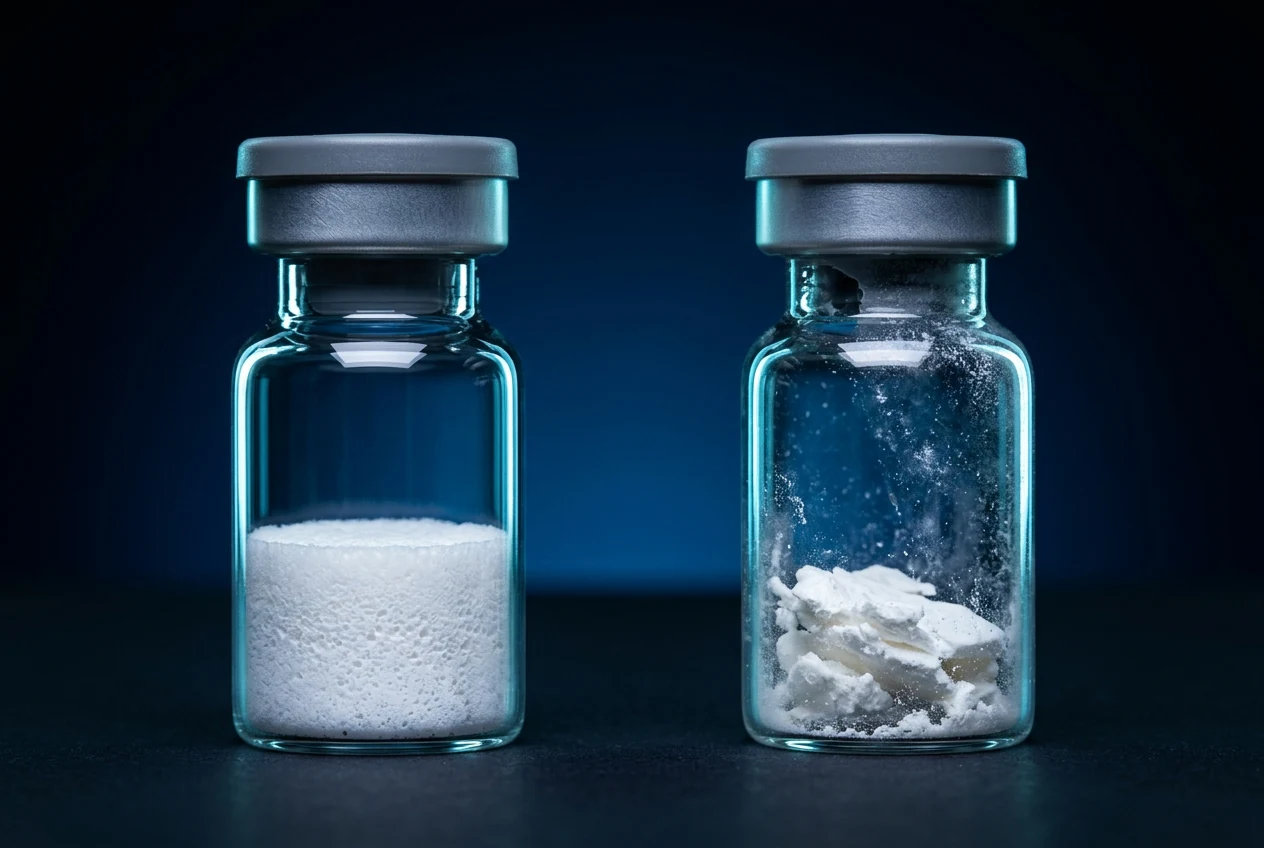
A problem vial usually gives itself away before anyone opens it: a lyophilized cake that has come loose or turned to powder, a color that does not match the compound, a crimp that was never seated properly, no lot number on the label. But the most common form of fraud, underdosing, is invisible. It has no smell, and it does not change how the powder looks. When someone asks about a fake peptide, how to tell is treated as a question for the eye, and the eye only answers part of it.
Two separate problems get confused constantly, so it helps to split them at the start. A degraded vial once held the correct compound and was ruined by heat, moisture, or time. A counterfeit vial never held it, or held less than the label declares. Visual inspection catches the first case reasonably well and almost none of the second.
1. What shows before opening: seal, label, lot number
The aluminum crimp should be firm. If the center disc shifts when you press it with a finger, or the crimped edge has play in it, the closure has lost integrity. Air got in, and with the air, moisture.
On the label, three quick checks:
- Lot number present and legible. A vial without a lot number is a vial without traceability. No certificate can be tied to it.
- Declared concentration and content, stated unambiguously (for example, "50 mg"), not as a range and not as an approximation.
- Agreement between label and certificate. The vial code must be the one that appears on the document, not another code from the same catalog.
Print quality helps less than people assume. A flawless label costs almost nothing to produce, and modern counterfeiting pays close attention to that detail.
2. The lyophilized cake: what it should look like
After lyophilization, the peptide sits as a cake, a compact porous disc adhering to the bottom of the vial, or as a thin film. That is the normal appearance.
Signs that something went wrong:
| Appearance | What it usually indicates |
|---|---|
| Compact, uniform cake, adhering to the bottom | Normal |
| Loose powder that shifts when the vial is tilted | The cake collapsed: possible moisture exposure or heavy vibration in transit |
| Shrunken cake, pulled away from the walls | Poor lyophilization cycle or loss of vacuum |
| Damp, sticky, or glassy appearance | Moisture uptake; the material has lost its dry form |
| Vial that appears empty | At small quantities (1–2 mg) this can be normal: the film is nearly invisible |
That last point drives constant complaints. A 2 mg vial of a peptide can look empty to the naked eye. That by itself is not fraud; it is the physics of two milligrams spread across the bottom of a 10 mL vial.
3. Color matters, and the GHK-Cu case
Most lyophilized peptides are white or off-white. A yellow, brown, or gray cast in a compound that should be white suggests degradation or oxidation.
The exception that shows why the rule is useful is GHK-Cu. The copper complex is intrinsically blue or blue-purple. A white GHK-Cu is not a better-purified GHK-Cu; it is, almost certainly, GHK without the copper, which makes it a different molecule. Here color is not a cosmetic detail but a piece of identity data, and it appears declared that way on the lot certificate: Blue Lyophilized Powder.
Glow Blend, which includes GHK-Cu in its composition, inherits that characteristic in proportion to its content.
4. On reconstitution: cloudiness, particles, dissolution time
Bacteriostatic water should run down the wall of the vial, not shoot straight into the cake. With that technique, most peptides dissolve in under a minute with a gentle swirl.
What should worry you:
- Persistent cloudiness. A solution still milky after several minutes points to material that is not dissolving.
- Visible particles or strands in suspension. Not normal under any circumstances.
- Heavy foam that does not settle. Usually the result of shaking instead of swirling, and vigorous shaking denatures peptides.
- Abnormally slow dissolution compared with earlier lots of the same compound.
One honest caveat: some compounds are legitimately less soluble and may need more time or a longer swirl. The useful signal is the change from what is expected for that specific compound, not a universal rule. The correct technique is laid out in the reconstitution guide.
5. What cannot be seen
This is the hard limit on everything above, and it should not be sold as anything else. It is also where how to tell a fake peptide stops being a visual exercise.
Underdosing. A vial that declares 10 mg and contains 4 mg looks exactly like a correct one. It is the most profitable fraud precisely because it is invisible: the product "works" enough not to raise immediate suspicion.
Partial substitution. Filling with mannitol, glycine, or another inert excipient produces a cake of perfectly normal appearance.
Microbial contamination or endotoxins. These do not necessarily alter the appearance of the lyophilizate and are detected only by specific assays.
Synthesis impurities. Truncated chains and byproducts are invisible to the naked eye and show up only on a chromatogram.
None of those four is resolved by looking at the vial. They are resolved with a certificate of analysis for the specific lot, verifiable with the laboratory that issued it.
6. The three most common frauds in the market
Systematic underdosing. Selling vials with a fraction of the declared content. Hard to detect without analysis, and economically very attractive to whoever does it.
Borrowed certificate. Publishing the analysis of a real lot, sometimes a genuinely good one, and attaching it to later lots that were never tested. The document itself is authentic; its association with the vial is false.
Compound substitution. Selling a cheaper molecule under the name of an expensive one, when the two look alike. Only mass confirmation detects it.
All three share the same antidote: the code on the vial in your hand should be searchable in the issuing laboratory's portal. Code verification exists precisely to close that gap.
7. When the problem is storage, not the seller
A sound vial spoils easily after purchase. Sealed lyophilizate is reasonably stable at room temperature for short periods, but once reconstituted the window narrows considerably and depends on the compound and the temperature.
The three factors that cause the most damage: sustained heat, repeated freeze-thaw cycles, and direct light in photosensitive compounds.
Before concluding that a product is fraudulent, reconstruct its history: how long it spent in transit, at what temperature, how long it has been reconstituted, and how it has been kept since. A considerable share of "bad peptides" are good peptides badly stored.
Frequently asked questions
My vial looks empty. Have I been cheated?
Not necessarily. At 1 to 5 mg, lyophilized material can form an almost transparent film at the bottom. Tilt the vial against a strong light and look at the base at an angle. If you still see nothing, the net content on the lot certificate is the figure that settles it.
The powder came loose and sits free at the bottom. Is it still usable?
A cake that collapsed from vibration in transit does not necessarily mean a loss of activity, but it does indicate the vial went through conditions it should not have. If there is also a damp appearance or a loose seal, there is reason not to use it.
Can I determine purity without sending it to a laboratory?
No. Purity is an instrumental measurement. What you can do without instruments is rule out vials with visible signs of degradation and insist on the certificate for that specific lot.
Is a yellowish peptide necessarily degraded?
A yellow cast in a compound that should be white is a reasonable warning sign, usually associated with oxidation. It is not conclusive proof, but it is reason enough not to use it and to request the lot analysis.
References
- U.S. Pharmacopeia. General Chapter <1> Injections and Implanted Drug Products — visual inspection requirements. usp.org
- U.S. Pharmacopeia. General Chapter <790> Visible Particulates in Injections. usp.org
- Pikal MJ. Freeze-drying of proteins: process, formulation, and stability. ACS Symposium Series, 1994. DOI: 10.1021/bk-1994-0567.ch008
- Pickart L, Margolina A. Regenerative and Protective Actions of the GHK-Cu Peptide in the Light of the New Gene Data. International Journal of Molecular Sciences, 2018;19(7):1987. DOI: 10.3390/ijms19071987
Written by the Bionic Editorial Team. Last reviewed: September 2026.
How we work: our editorial policy and source hierarchy.
This content is strictly educational and does not constitute medical advice, diagnosis or a therapeutic recommendation. The compounds mentioned are research products (Research Use Only) and are not approved by INVIMA, FDA, EMA or ANSM for therapeutic use in humans. Any health-related decision should be made with a licensed medical professional.