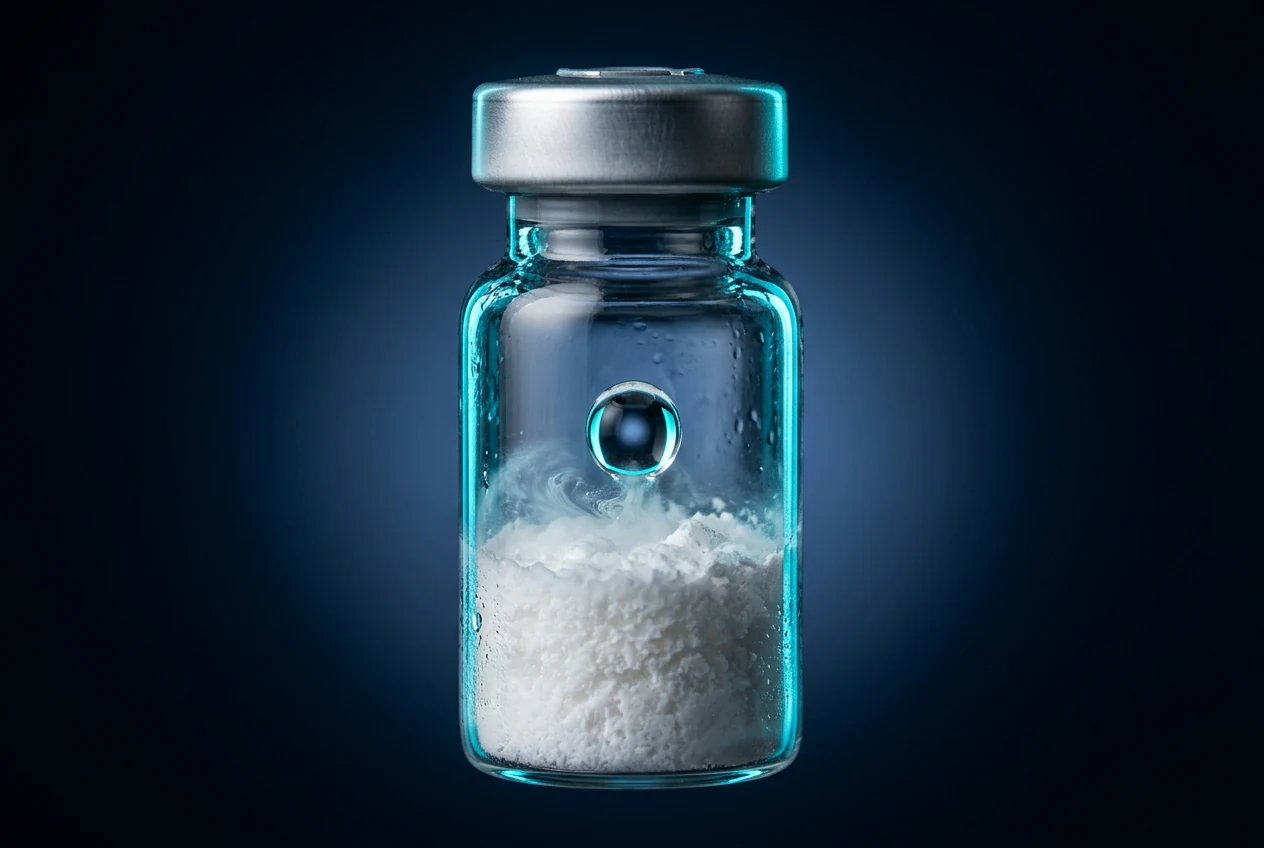
How to mix peptides comes down to a single operation: dissolving the lyophilized powder in a sterile diluent by letting the liquid run down the inside wall of the vial, without hitting the powder and without shaking. The resulting concentration depends on exactly two numbers, the milligrams in the vial and the milliliters added.
This article covers the technique and the arithmetic. It does not cover what dose anyone should use; that is not a laboratory operation, and it does not appear here.
What lyophilization is, and why the powder is fragile
Lyophilization freezes the peptide solution and removes the water by sublimation under vacuum: the ice turns straight to vapor without melting. What remains is a dry, porous structure (the cake) that keeps the molecule intact far longer than it would last in solution.
That process leaves two properties behind, and they govern everything that follows:
- The cake is hygroscopic. It pulls moisture out of the air. A vial left open or poorly sealed starts taking on water immediately.
- The structure is mechanically fragile. A pressurized jet of liquid breaks it apart, and that abrupt break-up puts the molecule under shear forces.
A peptide is not a salt you can beat into solution. It is a chain with a specific conformation, and excessive mechanical force can denature it (break that conformation) without the solution looking any different.
Choosing the diluent
The diluent is the first real decision in how to mix peptides. Three options are common, and they are not interchangeable.
| Diluent | What it is | When it's used |
|---|---|---|
| Bacteriostatic water | Sterile water with 0.9% benzyl alcohol as a preservative | The default when the vial will be accessed several times over a period of days |
| Sterile water for injection | Sterile water, no preservative | Immediate, single use; offers no protection against microbial growth |
| 0.9% sodium chloride | Sterile saline | When the compound's compatibility calls for it |
The practical difference is the preservative. Benzyl alcohol inhibits microbial growth, which is what makes repeated access to the vial workable. Sterile water without a preservative offers no such protection: once the stopper is pierced, every access is an opportunity for contamination.
One exception is worth knowing: some compounds are incompatible with benzyl alcohol or with saline, and the manufacturer says so. Where that instruction exists, it overrides the general rule. The detailed comparison is in bacteriostatic water versus sterile water.
The technique, step by step
1. Let the vial reach room temperature. If it came out of the refrigerator, take it out ahead of time. Introducing warm liquid into a cold vial encourages condensation.
2. Disinfect both stoppers. The peptide vial's and the diluent's, with an isopropyl alcohol swab. Let them dry; alcohol does not disinfect while it is still wet.
3. Draw up the diluent volume into the syringe, measuring precisely. This number sets the final concentration, so it is the wrong moment to round.
4. Insert the needle through the peptide vial's stopper with the bevel facing the wall. This is the step that separates a clean reconstitution from one that destroys product.
5. Let the liquid run down the inside wall. Do not push the plunger all the way in. A lyophilized vial usually holds a vacuum, and that vacuum tends to draw the liquid in: guide it, do not force it. The stream should never land directly on the cake.
6. Withdraw the needle and swirl the vial gently, in a slow circular motion, or simply let it sit. Most compounds dissolve in under a minute.
7. Never shake. Shaking creates foam, and foam is the visible sign that air-liquid interfaces are forming, which is where molecules denature.
8. Inspect it against the light. The solution should be clear and free of particles.
Calculating the concentration: the formula and three examples
The arithmetic is simple and does not depend on the compound:
Concentration (mg/mL) = milligrams in the vial ÷ milliliters of diluent added
Example 1: a 10 mg vial with 2 mL 10 ÷ 2 = 5 mg/mL. Each milliliter contains 5 mg.
Example 2: a 5 mg vial with 2.5 mL 5 ÷ 2.5 = 2 mg/mL.
Example 3: a 50 mg vial with 5 mL 50 ÷ 5 = 10 mg/mL.
Converting to syringe units
This is where most of the errors happen, because insulin syringes are not graduated in milliliters but in units.
On a U-100 syringe, 100 units equal 1 mL. So 1 unit = 0.01 mL.
At a concentration of 5 mg/mL:
- 1 mL (100 units) → 5 mg
- 0.1 mL (10 units) → 0.5 mg = 500 µg
- 0.02 mL (2 units) → 0.1 mg = 100 µg
The reconstitution calculator runs these conversions and shows the result directly in syringe units, which is how the volume gets measured in practice. The breakdown of why units are not micrograms is in the article on syringes and units.
A caveat about this section: the arithmetic is neutral; a calculation is either correct or it is not. How much any particular person should use is not arithmetic, and it is not on this site.
Five errors that degrade the contents
1. Firing the diluent straight at the cake. The most common error, and the most destructive. The force of the stream fragments the structure and puts the molecule under shear.
2. Shaking to speed up dissolution. Impatience is expensive here: the foam that appears is denaturation you can see. If a compound is slow, the answer is to wait or swirl more slowly, not to shake.
3. Calculating from the wrong volume. Adding 2 mL when 1 mL was written down halves the concentration. If the dosing math runs on the recorded number instead of the real one, everything downstream is wrong.
4. Reconstituting with an incompatible diluent. Using bacteriostatic water on a compound the manufacturer says to reconstitute with sterile water, or the other way around.
5. Leaving the reconstituted vial at room temperature. Stability in solution is counted in weeks under refrigeration and can drop to days outside the fridge. A reconstituted vial is a different product from a sealed one, with storage rules of its own.
Labeling and storage
As soon as the solution is ready, write three things on the vial:
- The reconstitution date.
- The resulting concentration in mg/mL.
- The volume of diluent added.
It looks like overkill until the third time someone stares at a vial and cannot remember whether it got 1 or 2 mL. At that point the contents stop being safely usable, because every calculation from then on is a guess.
On storage: refrigerated between 2 and 8 °C, protected from light, upright, and never frozen. Freezing a vial that has already been reconstituted is especially damaging: ice crystal formation and freeze-thaw cycles degrade the molecule. The compound-by-compound detail is in the storage guide.
What to do if it stays cloudy or will not dissolve
Cloudiness that persists after several minutes. Let the vial sit for half an hour at room temperature and swirl it gently again. Some compounds are legitimately slow. If it stays milky, do not use it: there is material that has not gone into solution.
Particles or strands in suspension. Not normal under any circumstances. Discard it.
Heavy foam. If it appears, stand the vial upright until it settles. If shaking caused it, part of the contents may already be compromised.
Dissolution far slower than in earlier lots of the same compound. That relative change is a more useful signal than any absolute rule. Check it against the lot certificate and review the visible signs of a problem vial.
What this guide does not settle
Knowing how to mix peptides correctly has limits, and they are worth stating plainly.
Correct technique does not guarantee that the contents match the label: an underdosed vial reconstitutes just as smoothly. The lot certificate settles that, not the procedure.
Stability after reconstitution is not characterized with the same rigor for every compound. The figures in circulation come in large part from extrapolation and manufacturer data, not from published stability studies for each molecule.
And the sterility of a multi-dose vial depends on technique at every access, not on the preservative alone. Benzyl alcohol inhibits growth; it does not sterilize a contaminated needle.
Frequently asked questions
How much diluent should I add to a vial?
There is no universally correct amount: the choice sets the concentration and, with it, the volume that has to be measured afterward. Larger volumes make small amounts easier to measure accurately; smaller volumes concentrate the solution further. The calculator lets you try combinations and see the conversion into units.
Can I reconstitute with tap water or bottled water?
No. Neither one is sterile, and neither has a controlled composition. Reconstitution requires a sterile, pharmaceutical-grade diluent.
How long does a vial last once reconstituted?
It depends on the compound, the diluent, and the temperature. Refrigerated and with bacteriostatic water, the range manufacturers usually state is counted in weeks; without a preservative, much less. Check the instruction for the specific compound and write down the date.
The vial drew the liquid in on its own. Is that normal?
Yes. Lyophilized vials usually hold a vacuum, and that vacuum draws the diluent in. Follow the movement instead of forcing the plunger; it is preferable to a pressurized stream.
Can I re-lyophilize a reconstituted peptide?
Not with home equipment. Lyophilization requires controlled freezing and vacuum equipment. Freezing a solution in a household freezer is not lyophilizing it: it is damaging it.
References
- U.S. Pharmacopeia. General Chapter <797> Pharmaceutical Compounding — Sterile Preparations. usp.org
- Pikal MJ. Freeze-drying of proteins: process, formulation, and stability. ACS Symposium Series, 1994;567:120–133. DOI: 10.1021/bk-1994-0567.ch008
- Wang W. Lyophilization and development of solid protein pharmaceuticals. International Journal of Pharmaceutics, 2000;203(1–2):1–60. DOI: 10.1016/S0378-5173(00)00423-300423-3)
- U.S. Food and Drug Administration. Benzyl alcohol — inactive ingredient information. fda.gov
Written by the Bionic Editorial Team. Last reviewed: August 2026.
How we work: our editorial policy and source hierarchy.
This content is strictly educational and does not constitute medical advice, diagnosis or a therapeutic recommendation. The compounds mentioned are research products (Research Use Only) and are not approved by INVIMA, FDA, EMA or ANSM for therapeutic use in humans. Any health-related decision should be made with a licensed medical professional.