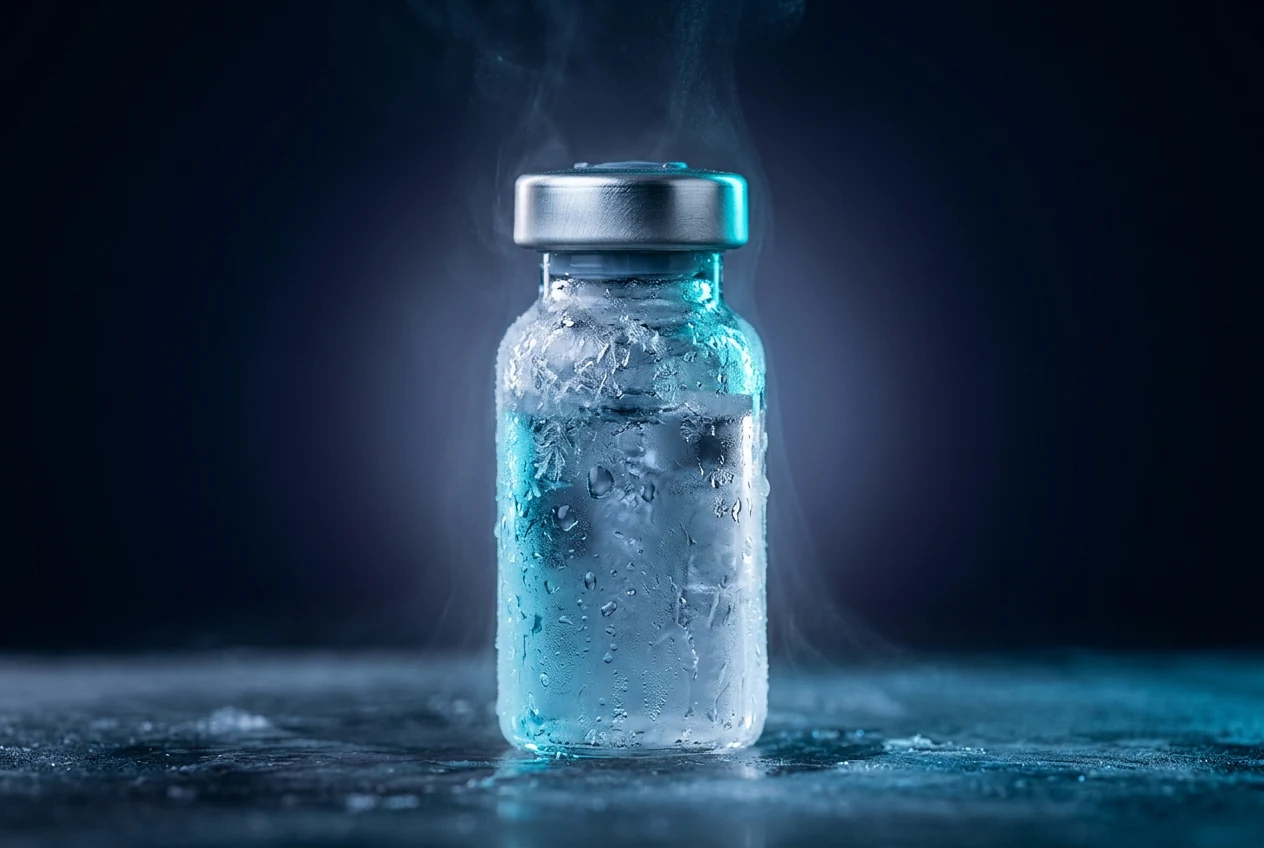
A sealed lyophilized peptide kept between 2 and 8 °C, away from light, is relatively stable. Once reconstituted, the clock starts running: the molecule sits in solution, exposed to hydrolysis and oxidation, and the useful window narrows from months to weeks. Almost everything about how to store peptides follows from that split between the two states.
The four enemies
Heat. It speeds up every degradation reaction. Hydrolysis of the peptide bond, oxidation of sensitive residues and aggregation all accelerate with temperature. A brief spell at room temperature rarely ruins a lyophilized vial; sustained exposure to 30 °C over weeks is a different matter.
Light. Certain amino acids (tryptophan, tyrosine, phenylalanine, cysteine) absorb ultraviolet light and can undergo photodegradation. That is why vials are usually kept in their box rather than out in the open.
Agitation. This is the enemy that gets the least respect, because it does not look harmful. The shear forces and air-liquid interfaces that agitation creates denature proteins and peptides. Foam is its visible sign.
Freeze-thaw cycles. Each cycle forms ice crystals that mechanically damage the molecule and concentrate solutes in the remaining liquid fraction, which shifts the local pH. One cycle may be tolerable; several are not.
Sealed lyophilized powder: the real margins
The lyophilized state is remarkably stable because almost no free water is left to take part in hydrolysis reactions.
| Condition | Commonly stated margin |
|---|---|
| Frozen at −20 °C or below | The longest; counted in years |
| Refrigerated at 2–8 °C | Months to years, depending on the compound |
| Controlled room temperature | Weeks to months |
| Sustained heat (>30 °C) | Degrades at an accelerated rate |
These ranges come from manufacturer statements and from the general literature on the stability of lyophilized material. They are not published stability data for each specific compound, and that distinction is worth keeping in mind: most research peptides have no peer-reviewed stability study for their particular formulation.
One point that reassures anyone receiving a shipment: sealed lyophilized material tolerates a few days in transit at room temperature reasonably well. It is the state with the most margin.
Reconstituted: the window and its exceptions
In solution, everything changes. The molecule is exposed to water, and hydrolysis goes from irrelevant to dominant.
The figure that circulates most often, 28 days refrigerated, deserves a note about where it comes from: it is the preservative efficacy period stated by manufacturers of bacteriostatic water, not a stability study of the peptide. Two clocks run at the same time:
- The preservative's, which limits how long the vial stays protected against microbial growth.
- The molecule's, which depends on its sequence, on pH and on temperature.
Whichever runs out first governs, and for many compounds the second is not precisely characterized.
Rules that hold up without depending on a specific number:
- Refrigerate between 2 and 8 °C from the moment of reconstitution.
- Protect from light.
- Keep the vial upright.
- Do not freeze a solution that has already been reconstituted.
- Write the date on the vial.
Compounds with residues that are especially prone to oxidation have shorter windows. When the manufacturer states a specific margin, that figure takes precedence over any general rule.
To freeze or not to freeze
This is the question that causes the most confusion in any discussion of how to store peptides, and the answer depends on the state:
Sealed lyophilized: freezing is the more conservative option for long-term storage. With two conditions: the vial has to be well sealed, and it should come back to temperature before opening, to avoid condensation inside.
Reconstituted: no. Ice crystal formation damages the molecule, and repeated cycles are cumulative. If a solution does get frozen for some reason, it should be thawed under refrigeration (never in hot water, never rushed at room temperature) and never frozen again.
The most common mistake in this area is not freezing. It is keeping the vial in the refrigerator door. The door swings more in temperature than any other part of the fridge. An inside shelf, toward the back, holds a much steadier temperature.
Power outages, travel and transport
Power outage. A closed refrigerator holds its temperature for several hours. The rule is not to open it. For longer outages, an insulated container with cold packs (no direct contact between the pack and the vial, so the vial does not freeze) covers the gap.
Travel. A cooler with cold packs, vials wrapped in insulating material so nothing touches directly. Never in the trunk of a car in the sun: it is the hottest spot in any vehicle.
Receiving a shipment. Lyophilized material that arrives at room temperature after a few days in transit is not necessarily compromised; it is the state that tolerates the most. What is worth checking on arrival are the visible signs of a problem vial: the seal, the look of the cake and the color.
How to label an open vial
Three pieces of information on the vial itself, written at the moment of reconstitution:
- Date of reconstitution.
- Resulting concentration in mg/mL.
- Volume of diluent added.
The third looks redundant next to the second, and it is not: it lets you rebuild the calculation if a doubt comes up later. Without it, a half-used vial turns into material of uncertain provenance, and any later measurement is a guess. The full procedure is in the reconstitution guide.
What the cold chain does not fix
Knowing how to store peptides does not improve a product that arrived in bad shape. If the material degraded before it got there, or if the contents were never what the label said, the refrigerator does not repair that.
It does not guarantee sterility either: cold slows microbial growth, it does not prevent it. A multi-dose vial contaminated during one access stays contaminated in the refrigerator.
And there is no home method for checking whether a peptide has kept its integrity. No color, smell or texture indicates it reliably. The only thing that answers that question is an analysis, which is why the batch certificate remains the reference document.
Frequently asked questions
My vial sat at room temperature for four days. Do I throw it out?
If it was sealed lyophilized, four days at room temperature falls within what that state usually tolerates. If it was reconstituted, the margin is much narrower and the decision is a different one.
Can I keep vials in the freezer compartment of my refrigerator?
Sealed lyophilized ones, yes, and it is the more conservative option for the long term. Reconstituted ones, no. And in no case in the door, which is where the temperature swings the most.
Why is 28 days quoted if it depends on the compound?
Because 28 days is the preservative efficacy period stated by manufacturers of bacteriostatic water. It has been adopted as a general reference, but it is not a stability figure for the peptide. When the manufacturer of the compound states its own margin, that one governs.
Does the refrigerator light matter?
It is a brief, intermittent exposure with very little ultraviolet component. The real risk is direct sunlight or prolonged exposure. Keeping the vials in their box settles the matter, with nothing further to weigh.
References
- Manning MC, et al. Stability of Protein Pharmaceuticals: An Update. Pharmaceutical Research, 2010;27(4):544–575. DOI: 10.1007/s11095-009-0045-6
- Wang W. Lyophilization and development of solid protein pharmaceuticals. International Journal of Pharmaceutics, 2000;203(1–2):1–60. DOI: 10.1016/S0378-5173(00)00423-300423-3)
- Wang W. Instability, stabilization, and formulation of liquid protein pharmaceuticals. International Journal of Pharmaceutics, 1999;185(2):129–188. DOI: 10.1016/S0378-5173(99)00152-000152-0)
- U.S. Pharmacopeia. General Chapter <51> Antimicrobial Effectiveness Testing. usp.org
- International Council for Harmonisation. ICH Q1A(R2): Stability Testing of New Drug Substances and Products. ich.org
Written by the Bionic Editorial Team. Last reviewed: August 2026.
How we work: our editorial policy and source hierarchy.
This content is strictly educational and does not constitute medical advice, diagnosis or a therapeutic recommendation. The compounds mentioned are research products (Research Use Only) and are not approved by INVIMA, FDA, EMA or ANSM for therapeutic use in humans. Any health-related decision should be made with a licensed medical professional.