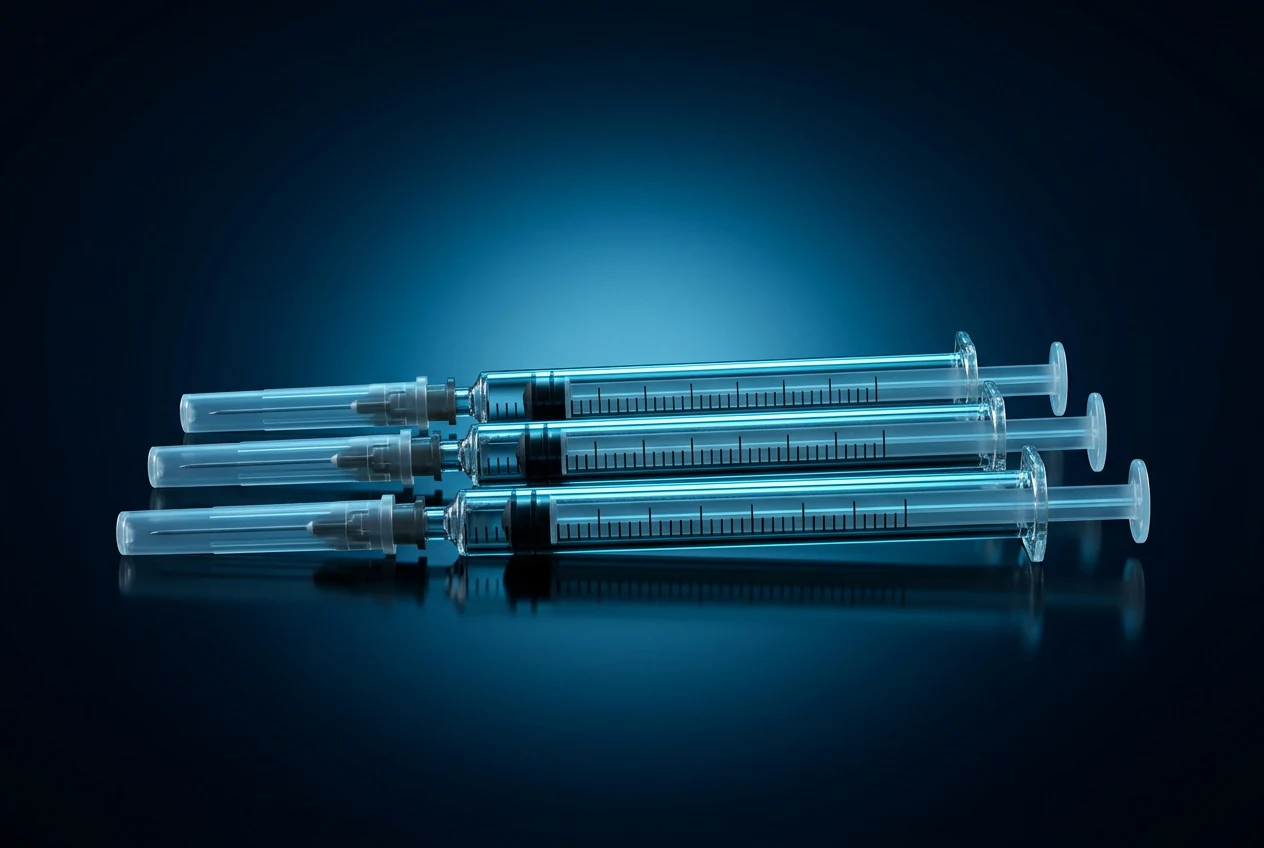
A 0.3 mL syringe has a mark every half unit, so it measures small volumes precisely. A 1 mL syringe is marked in steps of two units. Below 30 units, the 1 mL syringe introduces a relative error that can exceed 10%. Choosing the best syringe for peptides is a question of graduation, not capacity.
The three sizes and how they are really marked
Capacity is not what matters. What matters is how often there is a mark, because that interval is the smallest amount you can read without estimating.
| Capacity | Full scale | Mark every | Practical precision |
|---|---|---|---|
| 0.3 mL | 30 units | 0.5 units | High |
| 0.5 mL | 50 units | 1 unit | Medium |
| 1 mL | 100 units | 2 units | Low for small volumes |
Graduations vary somewhat between manufacturers. The table lists the most common ones, and it is always worth looking at the syringe itself before taking a scale for granted.
The precision rule
The reading error of a syringe is roughly half its smallest mark. That error is absolute, not relative: it weighs the same at 5 units as at 80. What changes is how much of the total it represents.
With a 1 mL syringe, marked in steps of two:
| Volume measured | Approximate error | Relative error |
|---|---|---|
| 80 units | ±1 unit | 1.3% |
| 40 units | ±1 unit | 2.5% |
| 10 units | ±1 unit | 10% |
| 5 units | ±1 unit | 20% |
With a 0.3 mL syringe, marked every half unit, the error drops to ±0.25 units: measuring 10 units goes from 10% error to 2.5%.
The working rule: the best syringe for peptides is the smallest one the volume you need to measure will fit in. A half-full syringe measures better than one used only in its first tenth.
Gauge and needle length
Two more numbers printed on the barrel, and two that get confused.
Gauge (G) measures thickness, and it runs backward from intuition: the higher the number, the thinner the needle. A 31G is thinner than a 29G. Thinner needles are less uncomfortable, but they bend more easily and slow down filling the syringe with dense liquids.
Length in millimeters determines how deep the needle reaches. Short needles (4 to 6 mm) are designed for subcutaneous deposit; longer ones raise the chance of reaching muscle, where absorption is different.
In insulin therapy, guidelines have converged on short needles precisely because they reduce the risk of intramuscular injection without compromising the deposit.
Volume → syringe reference table
| Volume to measure | Recommended syringe |
|---|---|
| Under 15 units (0.15 mL) | 0.3 mL |
| 15 to 30 units | 0.3 mL |
| 30 to 50 units | 0.5 mL |
| Over 50 units | 1 mL |
If the volume to be measured sits consistently below 10 units even with the smallest syringe, the syringe is not the problem: the concentration is too high. The fix is in the reconstitution, using more diluent. The calculator lets you test combinations before reconstituting, and the conversion guide explains how concentration and volume relate.
Reuse: why not
Reusing a syringe looks harmless. It is not, for three separate reasons.
The edge deforms on the first use. Electron microscopy images of used needles show tip deformation after a single puncture. A deformed tip tears instead of cutting, and repeated tissue damage contributes to lipohypertrophy.
The silicone lubricant is lost. It is what lets the needle go in with little resistance. Without it, entry is rougher and more uncomfortable.
Sterility ends. A used needle has been in contact with skin and tissue. Putting it back into a multidose vial transfers that load to the contents.
Cumulative tissue damage relates directly to the erratic absorption described in the article on site rotation.
What the right syringe does not solve
Choosing the syringe well bounds measurement error. It bounds nothing else.
It does not correct a wrong concentration calculation: measuring a badly calculated volume precisely gives a precise, wrong result. It does not make up for a poorly reconstituted vial. And it says nothing about what amount is appropriate, which is a different kind of question and not one this site answers.
Frequently asked questions
Can I use a 1 mL syringe for everything?
You can, but for small volumes the relative error grows a lot. Below 15 units, the difference between a 1 mL syringe and a 0.3 mL syringe is an order of magnitude in precision.
Which gauge is better?
It depends on the balance between comfort and handling. Thinner needles (31G, 32G) are less uncomfortable but bend easily and draw more slowly. A 29G or 30G is sturdier.
Do insulin syringes work for any reconstituted peptide?
They work as an instrument for measuring volume. What does not carry over is the scale: their "units" are volume marks, not units of compound activity. The full explanation is in the conversion article.
Do air bubbles matter?
Yes. A bubble takes up volume that reads as liquid, so you measure less than intended. With the needle pointing up, tap the barrel gently so the bubbles rise, and expel them before setting the measurement.
References
- Frid AH, et al. New Insulin Delivery Recommendations. Mayo Clinic Proceedings, 2016;91(9):1231–1255. DOI: 10.1016/j.mayocp.2016.06.010
- U.S. Pharmacopeia. General Chapter <1> Injections and Implanted Drug Products. usp.org
- U.S. Food and Drug Administration. Safely Using Sharps (Needles and Syringes) at Home, at Work and on Travel. fda.gov
Written by the Bionic Editorial Team. Last reviewed: August 2026.
How we work: our editorial policy and source hierarchy.
This content is strictly educational and does not constitute medical advice, diagnosis or a therapeutic recommendation. The compounds mentioned are research products (Research Use Only) and are not approved by INVIMA, FDA, EMA or ANSM for therapeutic use in humans. Any health-related decision should be made with a licensed medical professional.