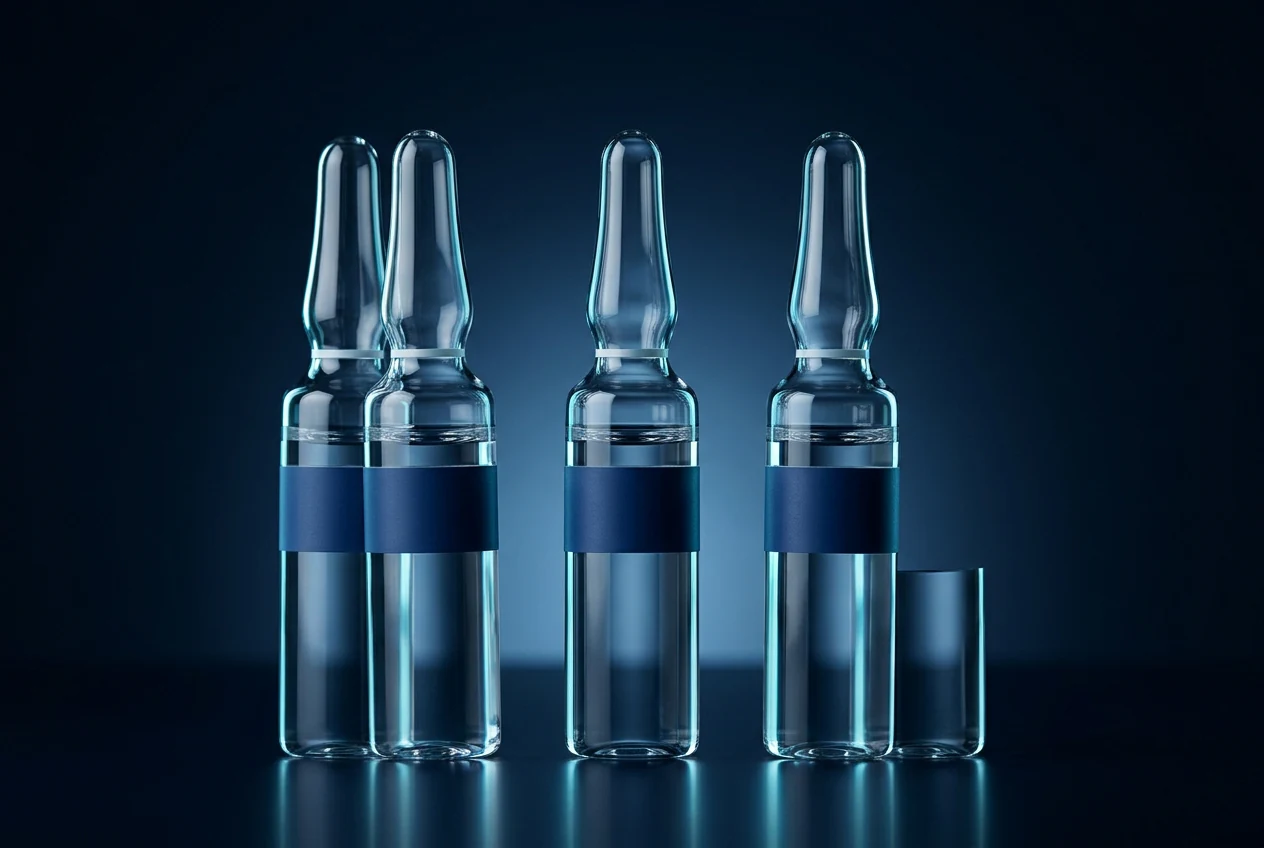
Bacteriostatic water contains 0.9% benzyl alcohol as a preservative, which is what allows the same vial to be drawn from several times over a span of weeks. That single ingredient separates bacteriostatic water for peptides from sterile water, which carries no preservative and is meant for one procedure. Saline adds isotonic sodium chloride on top of the water.
The three diluents and what is in them
| Diluent | Composition | Vial entries | Preservative |
|---|---|---|---|
| Bacteriostatic water | Water for injection + 0.9% benzyl alcohol | Multiple | Yes |
| Sterile water for injection | Water for injection, nothing else | One | No |
| Sodium chloride 0.9% | Water + NaCl 9 mg/mL | One (or multiple if the presentation declares it) | Depends on the presentation |
The difference between the first two is a single substance at 0.9%, and it decides whether a vial lasts three weeks or one afternoon.
What benzyl alcohol actually does
Benzyl alcohol is a well-established pharmaceutical antimicrobial preservative. It works by disrupting the bacterial cell membrane: at 0.9% it inhibits the growth of microorganisms that may be introduced when the stopper is pierced.
Two points get lost constantly:
It inhibits; it does not sterilize. A vial of bacteriostatic water does not disinfect a dirty needle and does not rescue a solution that is already contaminated. It slows the multiplication of a small load. It does not clear a large one.
The preservative gets diluted too. If a very small volume of bacteriostatic water is added to a vial, the final benzyl alcohol concentration can end up below the effective threshold. Protection is not a switch; it depends on the resulting concentration.
Which diluent for which situation
Two questions decide whether bacteriostatic water for peptides is the right choice: how many times the vial will be entered, and whether the compound carries a specific instruction from the manufacturer.
| Situation | Indicated diluent | Why |
|---|---|---|
| Vial used across several days or weeks | Bacteriostatic | The only one that protects between entries |
| Single-use vial, consumed immediately | Sterile or bacteriostatic | With no repeat entries, the preservative adds nothing |
| Manufacturer expressly specifies sterile water | Sterile | The compound's instruction overrides the general rule |
| Compound with a declared incompatibility with benzyl alcohol | Sterile | See the next section |
| Manufacturer specifies saline | Sodium chloride 0.9% | Compatibility or required tonicity |
The working rule: if the vial will be opened more than once, bacteriostatic, unless the compound says otherwise.
The cases where benzyl alcohol is a problem
It is not a universally harmless preservative, and there are three documented situations where it matters.
Neonatal population. Benzyl alcohol is contraindicated in newborns. Exposure was historically associated with what became known as gasping syndrome, which is why pediatric presentations avoid it. This is the best-established contraindication for the substance.
Individual hypersensitivity. Hypersensitivity reactions to benzyl alcohol exist; they are uncommon but described.
Incompatibility with the compound. Some peptides carry an instruction to reconstitute with sterile water for reasons of stability or compatibility. When the manufacturer declares it, that instruction takes precedence over any general rule, including the one in this article.
None of these three situations is settled by a general rule found on the internet. If one applies, it is a conversation with a healthcare professional, not a laboratory handling decision.
Storing the diluent itself
The diluent has rules of its own, and they get ignored because it looks like "just water."
- Unopened: controlled room temperature, protected from light, within the printed expiration date.
- Once pierced: bacteriostatic water keeps its preservative action for a limited period declared by the manufacturer, usually 28 days, after which it should be discarded even if liquid remains.
- Sterile water, once pierced, is no longer considered sterile for later use. Its window is the single procedure.
- Do not transfer between vials and do not top them off. Every transfer is one more chance for contamination.
The 28 days for bacteriostatic water are a figure from the diluent manufacturer, not from the peptide. Two separate clocks run in parallel: the preservative's and the compound's stability in solution. The one that runs out first governs. The margins for the second are in the cold chain guide.
What the choice of diluent does not solve
Choosing bacteriostatic water for peptides correctly protects against microbial growth between entries. It protects against nothing else.
It does not improve the peptide's chemical stability: hydrolysis, oxidation, and aggregation run their course with or without a preservative. It does not make up for a rough reconstitution technique, and it does not replace swabbing the stopper at every entry.
The 28-day figure also deserves an honest note. It comes from studies of the preservative itself under controlled conditions, not from a stability study of a specific peptide in that diluent. For most research compounds, that specific study simply has not been published.
Frequently asked questions
Can I use expired bacteriostatic water if it looks fine?
No. The expiration date refers to the guaranteed effectiveness of the preservative, and that effectiveness is not visible to the eye. Expired bacteriostatic water can look perfect and have lost its ability to inhibit growth.
Are saline and bacteriostatic water interchangeable?
Not automatically. Saline adds sodium chloride, which can affect the solubility or the stability of some compounds. It is used when the manufacturer specifies it, not as a substitute for convenience.
How much benzyl alcohol ends up being administered?
It depends on the volume. At the usual reconstitution volumes, the total mass of preservative is very small. The clinical relevance of that exposure is well characterized only in specific populations (neonates above all), and it is a question for a healthcare professional to weigh.
Does bacteriostatic water work for every peptide?
It is the default option for multi-dose vials, but it is not universal. The instruction from the manufacturer of the specific compound always governs when there is one.
References
- U.S. Pharmacopeia. Bacteriostatic Water for Injection — monograph. usp.org
- U.S. Food and Drug Administration. Benzyl alcohol — Inactive Ingredient Database. fda.gov
- Gershanik J, et al. The gasping syndrome and benzyl alcohol poisoning. New England Journal of Medicine, 1982;307(22):1384–1388. DOI: 10.1056/NEJM198211253072206
- U.S. Pharmacopeia. General Chapter <51> Antimicrobial Effectiveness Testing. usp.org
Written by the Bionic Editorial Team. Last reviewed: August 2026.
How we work: our editorial policy and source hierarchy.
This content is strictly educational and does not constitute medical advice, diagnosis or a therapeutic recommendation. The compounds mentioned are research products (Research Use Only) and are not approved by INVIMA, FDA, EMA or ANSM for therapeutic use in humans. Any health-related decision should be made with a licensed medical professional.