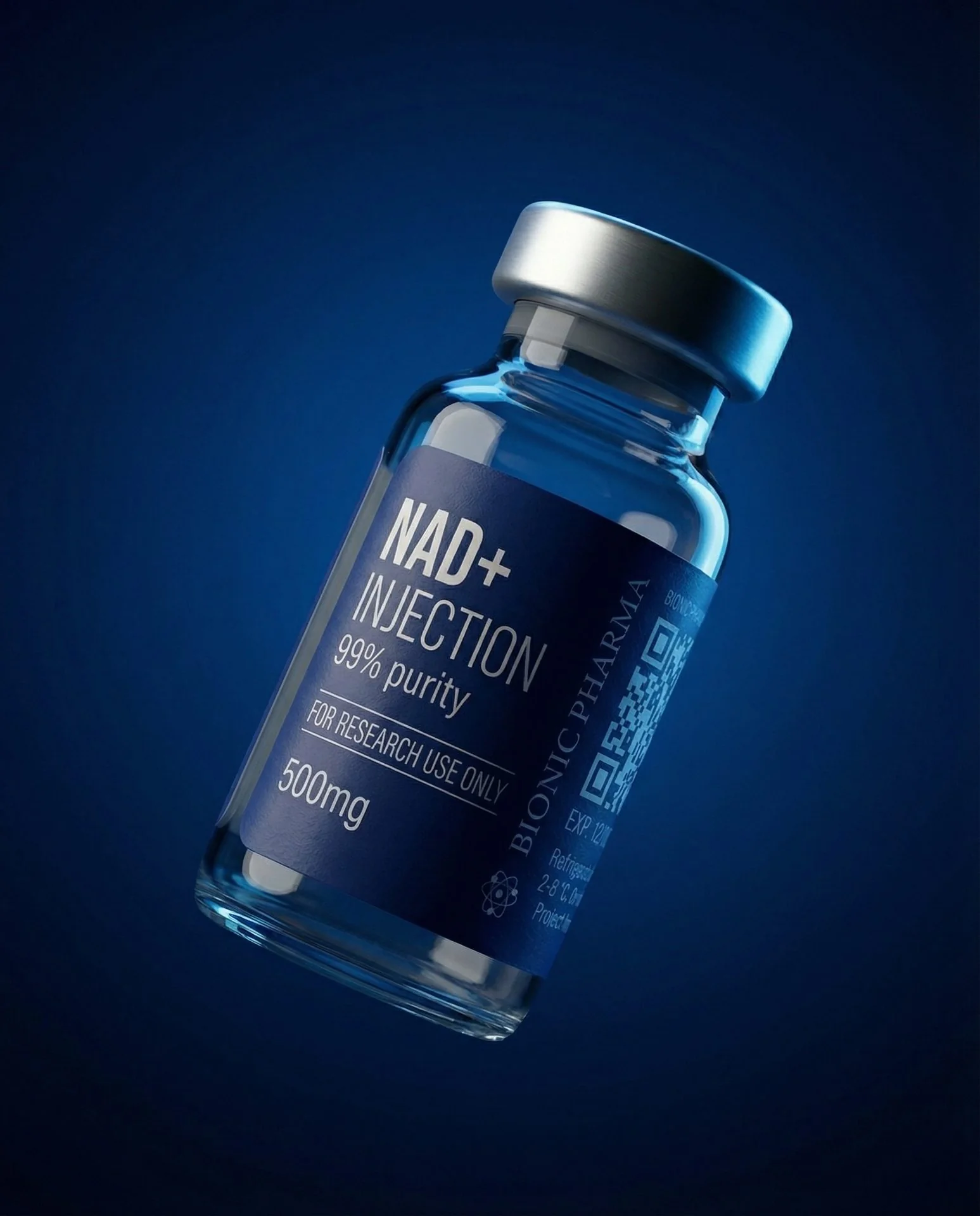
NAD+

NAD+

04
Cellular cofactor and mitochondrial longevity
99% Purity Longevity Cellular Energy

NAD+ (Nicotinamide Adenine Dinucleotide) is an essential coenzyme present in every cell that takes part in more than 500 metabolic reactions, primarily in energy production (ATP) and DNA repair. Its levels decline drastically with age, and exogenous replenishment is associated with improvements in energy, mitochondrial function, cognitive function and longevity markers. It is one of the pillars of modern anti-aging biohacking.

Key Benefits
Boosts cellular energy and ATP
Activates longevity sirtuins
Improves mental clarity and focus
Reduces chronic fatigue
Repairs DNA and protects mitochondria
Speeds physical and mental recovery
Mechanism of Action
NAD+ acts as an essential coenzyme in more than 500 metabolic reactions, primarily in energy production (ATP) and DNA repair, and activates the sirtuins, enzymes associated with longevity and cellular protection. By replenishing its levels, which decline with age, it is associated with restored mitochondrial function and improved longevity markers.
Protocol

Reconstitution & Usage Protocol

Important: Only chill the water for 3 minutes before reconstituting the peptide. Do not prepare it with very cold water, because it can freeze, lose effectiveness or be damaged.
1Reconstitution
Materials: 1 vial of NAD+ 500 mg · 1 vial of bacteriostatic water · U-100 insulin syringe · 3 mL syringe · alcohol wipes.
  1. Let the vial reach room temperature for 15–20 minutes.
  2. Disinfect the rubber caps with an alcohol wipe.
  3. Draw 3 mL of bacteriostatic water with the 3 mL syringe.
  4. Inject the water slowly down the wall of the NAD+ vial. The solution should be clear or slightly yellowish.
  5. Do not shake. Swirl gently for 60 seconds until fully dissolved.
Label with the date and refrigerate (2–8 °C). Protect from light. Stable for 28 days.
2Concentration & Dosing
Reconstituting 500 mg in 3 mL → 166.6 mg/mL ≈ 1.66 mg per UI.
Target doseUnitsVolume
50 mg (starting)30 UI0.30 mL
100 mg (standard)60 UI0.60 mL
200 mg (high)120 UI1.20 mL
Universal formula: UI = (dose in mg ÷ 1.66)
3Application
Route
Subcutaneous (more comfortable) or intramuscular. Inject very slowly (5–10 min) to avoid a sensation of pressure/flushing.
Frequency
2–3 times per week.
Cycle
4–6 weeks with a 2-week break.
  • Key tip: always start with low doses (50 mg) to assess tolerance; facial flushing is common but transient.
  • Before applying: let the loaded dose lose its chill (only the amount to be injected) — hold the syringe in your hand for 2–3 minutes.
  • After applying: gently massage the area for ~40 seconds to disperse the peptide and improve absorption.
Importante: Solo poner a enfriar el agua 3 minutos antes de reconstituir el péptido. No preparar con agua muy fría, porque se puede congelar, perder efecto o dañarse.
1Reconstitución
Materiales: 1 vial de NAD+ 500 mg · 1 vial de agua bacteriostática · jeringa de insulina U-100 · jeringa de 3 mL · toallitas de alcohol.
  1. Atemperar el vial 15–20 minutos a temperatura ambiente.
  2. Desinfectar las tapas de goma con toallita de alcohol.
  3. Cargar 3 mL de agua bacteriostática con jeringa de 3 mL.
  4. Inyectar el agua lentamente por la pared del vial de NAD+. La solución debe quedar transparente o ligeramente amarillenta.
  5. No agitar. Girar suavemente 60 segundos hasta disolución total.
Etiquetar con fecha y refrigerar (2–8 °C). Proteger de luz. Estable 28 días.
2Concentración y dosis
Reconstituyendo 500 mg en 3 mL → 166,6 mg/mL ≈ 1,66 mg por UI.
Dosis objetivoUnidadesVolumen
50 mg (inicial)30 UI0,30 mL
100 mg (estándar)60 UI0,60 mL
200 mg (alta)120 UI1,20 mL
Fórmula universal: UI = (dosis en mg ÷ 1,66)
3Aplicación
Vía
Subcutánea (más cómoda) o intramuscular. Inyectar muy lentamente (5–10 min) para evitar sensación de presión/flushing.
Frecuencia
2–3 veces por semana.
Ciclo
4–6 semanas con descanso de 2 semanas.
  • Tip clave: empezar siempre con dosis bajas (50 mg) para evaluar tolerancia; el flushing facial es común pero transitorio.
  • Antes de aplicar: dejar que la dosis cargada pierda el frío (solo la cantidad a inyectar) — sostener la jeringa en la mano 2–3 minutos.
  • Después de aplicar: masaje suave en la zona durante ~40 segundos para dispersar el péptido y mejorar absorción.
Important : Ne mettre l'eau à refroidir que 3 minutes avant de reconstituer le peptide. Ne pas préparer avec de l'eau très froide, car elle peut geler, perdre son effet ou s'abîmer.
1Reconstitution
Matériel : 1 flacon de NAD+ 500 mg · 1 flacon d'eau bactériostatique · seringue à insuline U-100 · seringue de 3 mL · lingettes alcoolisées.
  1. Laisser le flacon revenir à température ambiante pendant 15–20 minutes.
  2. Désinfecter les bouchons en caoutchouc avec une lingette alcoolisée.
  3. Prélever 3 mL d'eau bactériostatique avec la seringue de 3 mL.
  4. Injecter l'eau lentement le long de la paroi du flacon de NAD+. La solution doit être transparente ou légèrement jaunâtre.
  5. Ne pas agiter. Faire tourner doucement pendant 60 secondes jusqu'à dissolution totale.
Étiqueter avec la date et réfrigérer (2–8 °C). Protéger de la lumière. Stable 28 jours.
2Concentration et dosage
En reconstituant 500 mg dans 3 mL → 166,6 mg/mL ≈ 1,66 mg par UI.
Dose cibleUnitésVolume
50 mg (initiale)30 UI0,30 mL
100 mg (standard)60 UI0,60 mL
200 mg (élevée)120 UI1,20 mL
Formule universelle : UI = (dose en mg ÷ 1,66)
3Application
Voie
Sous-cutanée (plus confortable) ou intramusculaire. Injecter très lentement (5–10 min) pour éviter une sensation de pression/flushing.
Fréquence
2–3 fois par semaine.
Cycle
4–6 semaines avec une pause de 2 semaines.
  • Astuce clé : toujours commencer par de faibles doses (50 mg) pour évaluer la tolérance ; le flushing facial est fréquent mais transitoire.
  • Avant l'application : laisser la dose chargée perdre son froid (uniquement la quantité à injecter) — tenir la seringue dans la main pendant 2–3 minutes.
  • Après l'application : masser doucement la zone pendant ~40 secondes pour disperser le peptide et améliorer l'absorption.

Open dosage calculator →

Research Highlights

Research Highlights

FAQ

Frequently Asked Questions

What is NAD+ studied for in research?

In research models, NAD+ is investigated as an essential coenzyme involved in more than 500 metabolic reactions, mainly ATP energy production and DNA repair, as well as for its activation of sirtuins and its association with mitochondrial function and longevity markers. This material is for laboratory research use only.

How is the 500 mg vial reconstituted?

Per the reference protocol, 500 mg is reconstituted with 3 mL of bacteriostatic water injected slowly down the vial wall, yielding 166.6 mg/mL (≈ 1.66 mg per UI). The water should only be chilled for 3 minutes beforehand; very cold water can freeze, weaken or damage the peptide. Do not shake — swirl gently for 60 seconds until fully dissolved.

How are units (UI) and volume calculated per dose?

With a 166.6 mg/mL concentration, the universal formula is UI = (dose in mg ÷ 1.66). For reference, 50 mg corresponds to 30 UI / 0.30 mL, 100 mg to 60 UI / 0.60 mL, and 200 mg to 120 UI / 1.20 mL. These figures are research reference values only.

How should reconstituted NAD+ be stored?

Once reconstituted, label the vial with the date and refrigerate at 2–8 °C, protected from light. Under these conditions the solution is stable for 28 days. It should be clear or slightly yellowish after reconstitution.

Related Compounds

Related Compounds

← Back to full catalog