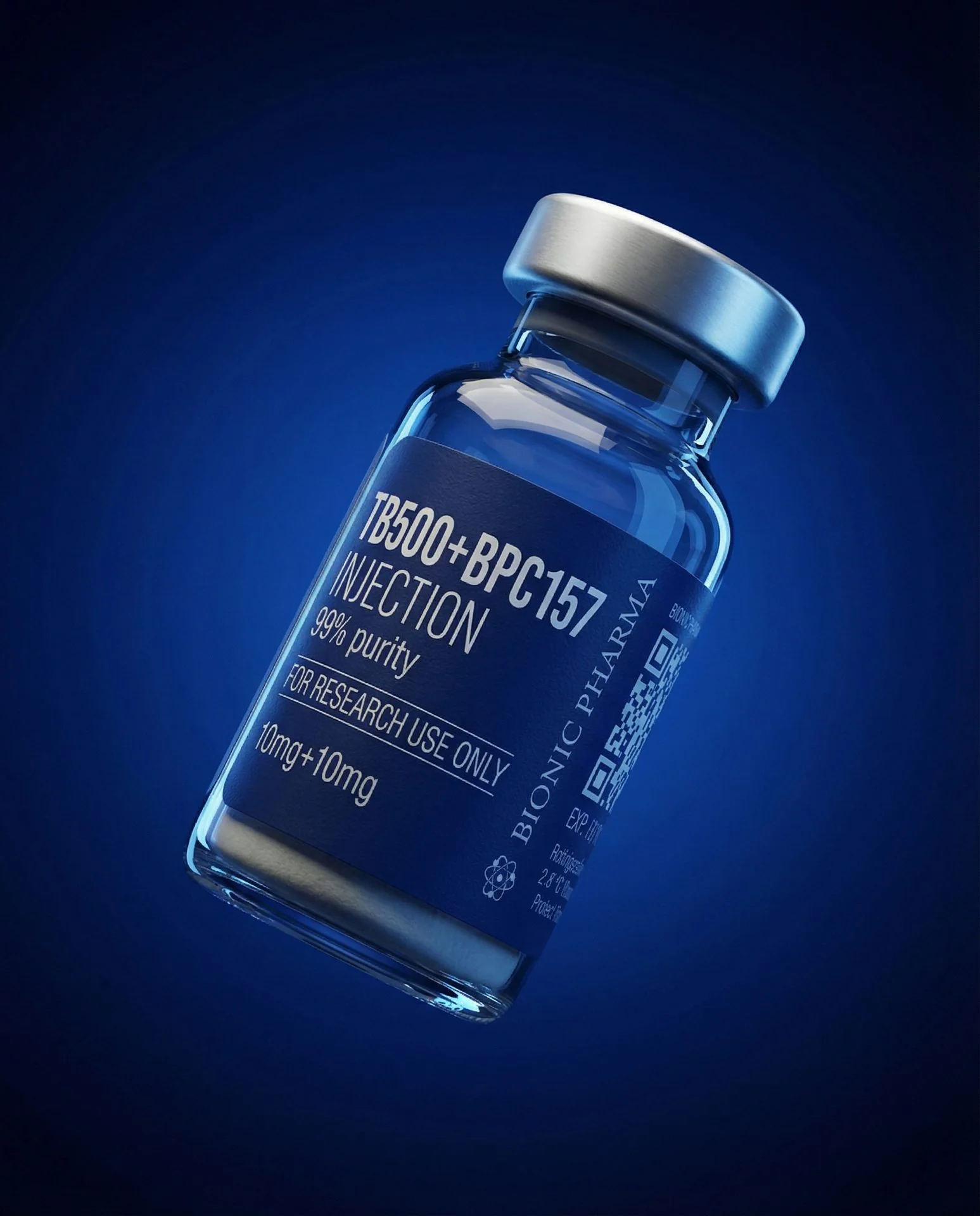
TB-500 + BPC-157 Blend

TB-500 + BPC-157 Blend

05
Regenerative duo · Accelerated recovery of injuries and tissues
99% Purity Repair Recovery

A synergistic blend that combines TB-500 (Thymosin Beta-4) and BPC-157 in a single vial (5 mg + 5 mg). TB-500 promotes cell migration and systemic angiogenesis, while BPC-157 accelerates local healing and protects tissues. Together they cover both repair mechanisms: systemic and focal. It is the reference protocol for soft-tissue injury recovery, especially chronic tendinopathies and complex sports injuries.

Key Benefits
Accelerated recovery of sports injuries
Regenerates tendons and ligaments
Reduces joint inflammation
Improves flexibility and mobility
Repairs post-surgical tissues
Systemic + local synergy
Mechanism of Action
TB-500 (Thymosin Beta-4) promotes cell migration and systemic angiogenesis, while BPC-157 accelerates local healing and protects tissues. Together they cover both repair mechanisms: systemic and focal.
Protocol

Reconstitution & Usage Protocol

Important: Only cool the water for 3 minutes before reconstituting the peptide. Do not prepare with very cold water, as it may freeze, lose effect or be damaged.
1Reconstitution
Materials: 1 vial of TB-500+BPC-157 10 mg (5+5) · 1 vial of bacteriostatic water · U-100 insulin syringe · alcohol wipes.
  1. Bring the vial to room temperature for 15–20 minutes.
  2. Disinfect the rubber stoppers with an alcohol wipe. Let dry for 30 seconds.
  3. Draw 2 mL of bacteriostatic water (200 IU).
  4. Inject the water slowly down the inner wall of the vial. Fragile peptides — no direct stream.
  5. Do not shake. Swirl gently for 30–60 seconds until the solution is clear.
Label with the date and refrigerate (2–8 °C). Stable for 28 days.
2Concentration & Dosing
Reconstituting 5 mg + 5 mg in 2 mL → 2.5 mg/mL of each = 25 mcg of each peptide per IU.
Target doseUnitsVolume
250+250 mcg10 IU0.10 mL
500+500 mcg (standard)20 IU0.20 mL
750+750 mcg30 IU0.30 mL
Universal formula: IU = (dose in mcg of each peptide ÷ 25)
3Application
Route
Subcutaneous in the abdomen (systemic effect) or near the injury (local effect).
Frequency
Once a day or every other day. Loading phase: daily dose during the first week; then maintenance 3–4 times/week.
Cycle
4–6 weeks with a 2–4 week rest.
  • Before applying: let the drawn dose lose its chill (only the amount to be injected) — hold the syringe in your hand for 2–3 minutes.
  • After applying: gentle massage of the area for ~40 seconds to disperse the peptide and improve absorption.
Importante: Solo poner a enfriar el agua 3 minutos antes de reconstituir el péptido. No preparar con agua muy fría, porque se puede congelar, perder efecto o dañarse.
1Reconstitución
Materiales: 1 vial TB-500+BPC-157 10 mg (5+5) · 1 vial de agua bacteriostática · jeringa de insulina U-100 · toallitas de alcohol.
  1. Atemperar el vial a temperatura ambiente 15–20 minutos.
  2. Desinfectar las tapas de goma con toallita de alcohol. Dejar secar 30 segundos.
  3. Cargar 2 mL de agua bacteriostática (200 UI).
  4. Inyectar el agua lentamente por la pared interior del vial. Péptidos frágiles — no chorro directo.
  5. No agitar. Girar suavemente 30–60 segundos hasta solución transparente.
Etiquetar con fecha y refrigerar (2–8 °C). Estable 28 días.
2Concentración y dosis
Reconstituyendo 5 mg + 5 mg en 2 mL → 2,5 mg/mL de cada uno = 25 mcg de cada péptido por UI.
Dosis objetivoUnidadesVolumen
250+250 mcg10 UI0,10 mL
500+500 mcg (estándar)20 UI0,20 mL
750+750 mcg30 UI0,30 mL
Fórmula universal: UI = (dosis en mcg de cada péptido ÷ 25)
3Aplicación
Vía
Subcutánea en abdomen (efecto sistémico) o cerca de la lesión (efecto local).
Frecuencia
1 vez al día o día por medio. Fase de carga: primera semana dosis diaria; luego mantenimiento 3–4 veces/semana.
Ciclo
4–6 semanas con descanso de 2–4 semanas.
  • Antes de aplicar: dejar que la dosis cargada pierda el frío (solo la cantidad a inyectar) — sostener la jeringa en la mano 2–3 minutos.
  • Después de aplicar: masaje suave en la zona durante ~40 segundos para dispersar el péptido y mejorar absorción.
Important : Mettre l'eau à refroidir seulement 3 minutes avant de reconstituer le peptide. Ne pas préparer avec de l'eau très froide, car elle pourrait geler, perdre son effet ou s'endommager.
1Reconstitution
Matériel : 1 flacon de TB-500+BPC-157 10 mg (5+5) · 1 flacon d'eau bactériostatique · seringue à insuline U-100 · lingettes alcoolisées.
  1. Ramener le flacon à température ambiante pendant 15–20 minutes.
  2. Désinfecter les bouchons en caoutchouc avec une lingette alcoolisée. Laisser sécher 30 secondes.
  3. Prélever 2 mL d'eau bactériostatique (200 UI).
  4. Injecter l'eau lentement le long de la paroi intérieure du flacon. Peptides fragiles — pas de jet direct.
  5. Ne pas agiter. Faire tourner doucement 30–60 secondes jusqu'à obtenir une solution transparente.
Étiqueter avec la date et réfrigérer (2–8 °C). Stable 28 jours.
2Concentration et dosage
En reconstituant 5 mg + 5 mg dans 2 mL → 2,5 mg/mL de chacun = 25 mcg de chaque peptide par UI.
Dose cibleUnitésVolume
250+250 mcg10 UI0,10 mL
500+500 mcg (standard)20 UI0,20 mL
750+750 mcg30 UI0,30 mL
Formule universelle : UI = (dose en mcg de chaque peptide ÷ 25)
3Application
Voie
Sous-cutanée dans l'abdomen (effet systémique) ou près de la lésion (effet local).
Fréquence
1 fois par jour ou un jour sur deux. Phase de charge : dose quotidienne la première semaine ; puis entretien 3–4 fois/semaine.
Cycle
4–6 semaines avec un repos de 2–4 semaines.
  • Avant l'application : laisser la dose prélevée perdre son froid (seulement la quantité à injecter) — tenir la seringue dans la main 2–3 minutes.
  • Après l'application : massage doux de la zone pendant ~40 secondes pour disperser le peptide et améliorer l'absorption.

Open dosage calculator →

Research Highlights

Research Highlights

FAQ

Frequently Asked Questions

What makes the TB-500 + BPC-157 blend synergistic in research models?

The blend pairs 5 mg of TB-500 with 5 mg of BPC-157 in one vial so that two complementary repair pathways are studied at once: TB-500 (Thymosin Beta-4) drives systemic cell migration and angiogenesis, while BPC-157 acts on local healing and tissue protection. Research frames this as covering both systemic and focal mechanisms of the connective-tissue repair cascade.

How is the 10 mg (5+5) vial reconstituted and dosed in studies?

Reconstituting 5 mg + 5 mg in 2 mL of bacteriostatic water yields 2.5 mg/mL of each component, equivalent to 25 mcg of each peptide per IU on a U-100 insulin syringe. Documented protocols use a standard 500+500 mcg draw (20 IU = 0.20 mL), with the universal conversion IU = (dose in mcg of each peptide ÷ 25).

Why is the water cooled for only 3 minutes before reconstitution?

Cooling the bacteriostatic water for only 3 minutes prevents the diluent from becoming too cold. Very cold water can freeze the solution, reduce activity or damage these fragile peptides, so the water is injected slowly down the inner wall and the vial is swirled gently rather than shaken.

What injection route and cycle length appear in the protocol?

The protocol uses subcutaneous administration in the abdomen for a systemic effect or near the injury for a local effect, once a day or every other day, with a daily loading week followed by maintenance 3–4 times per week. Cycles run 4–6 weeks with a 2–4 week rest; this material is for laboratory research use only.

Related Compounds

Related Compounds

← Back to full catalog