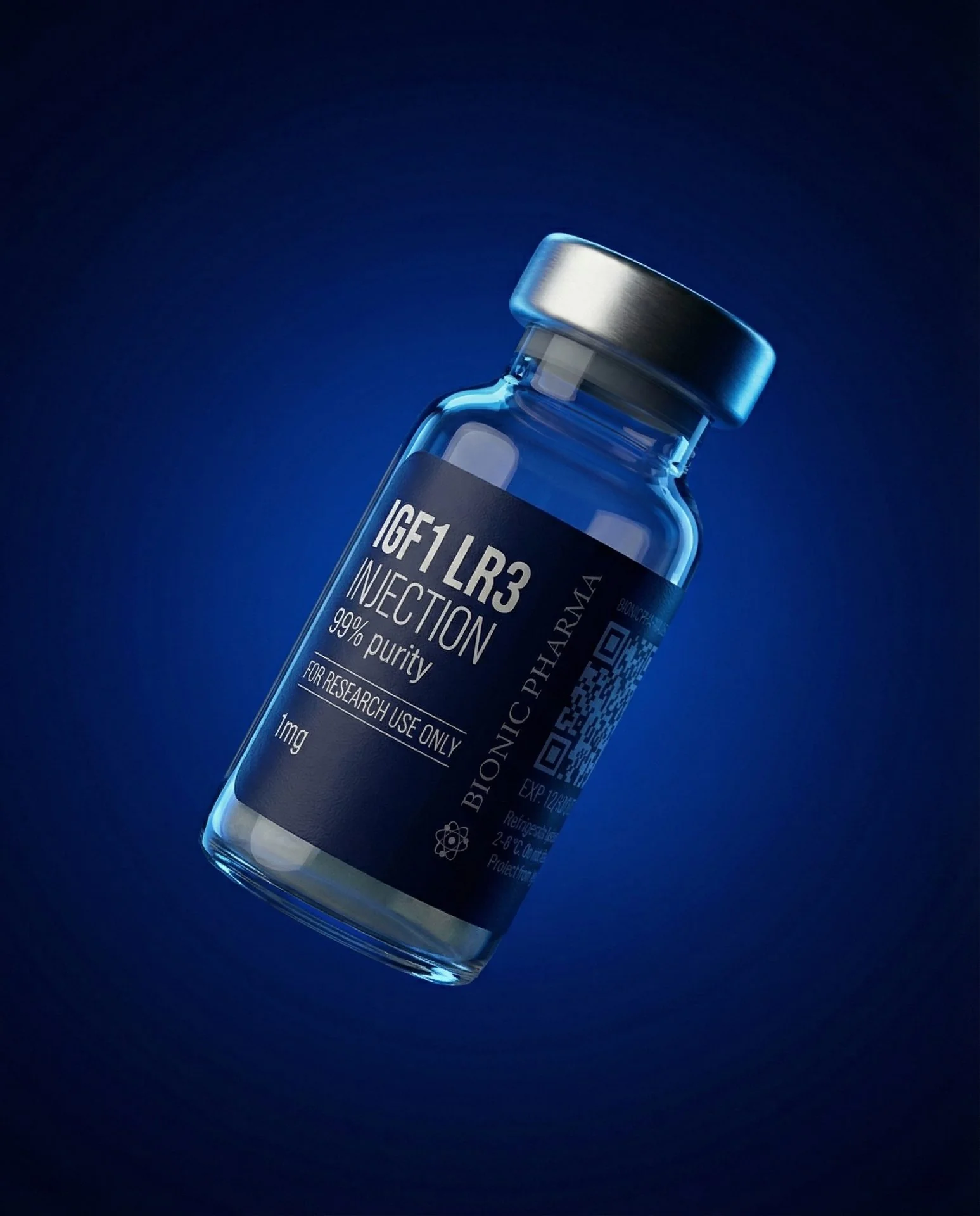
IGF-1 LR3 (Long R3 Insulin-like Growth Factor-1) is a modified version of natural IGF-1 with an extended half-life of ~20–30 hours (vs. 15 minutes for native IGF-1). It acts directly on IGF-1 receptors to stimulate protein synthesis, muscle hyperplasia (the creation of new muscle cells), and tissue recovery. It is one of the most potent compounds for lean-mass gain and repair in the performance world.
| Target dose | Units | Volume |
|---|---|---|
| 50 mcg (low) | 10 IU | 0.10 mL |
| 75 mcg (standard) | 15 IU | 0.15 mL |
| 100 mcg (high) | 20 IU | 0.20 mL |
| Dosis objetivo | Unidades | Volumen |
|---|---|---|
| 50 mcg (baja) | 10 UI | 0,10 mL |
| 75 mcg (estándar) | 15 UI | 0,15 mL |
| 100 mcg (alta) | 20 UI | 0,20 mL |
| Dose cible | Unités | Volume |
|---|---|---|
| 50 mcg (faible) | 10 UI | 0,10 mL |
| 75 mcg (standard) | 15 UI | 0,15 mL |
| 100 mcg (élevée) | 20 UI | 0,20 mL |
IGF-1 LR3 (Long R3) is a modified analog whose extended half-life of approximately 20–30 hours far exceeds the roughly 15 minutes of native IGF-1, prolonging receptor signaling in study models. An arginine substitution at position 3 reduces binding to IGF-binding proteins, leaving more peptide bioavailable. It is supplied strictly for in-vitro and laboratory research use.
Reconstituting the 1 mg (1000 mcg) vial with 2 mL of bacteriostatic water yields a 0.5 mg/mL solution, equal to 5 mcg per IU on a U-100 insulin syringe. The peptide is extremely fragile, so the water must be directed slowly down the vial wall and the solution swirled gently for 30 seconds rather than shaken. These figures describe laboratory handling only.
Study references typically describe a once-daily schedule, often beginning at 50 mcg/day for the first 2 weeks to gauge tolerance, with documented ranges of 50–100 mcg (10–20 IU). A 4-week-maximum framework followed by a mandatory 4-week rest reflects IGF-1 receptor downregulation under prolonged exposure. These figures describe the literature only and are not human-use instructions.
Because IGF-1 shares structural and signaling features with insulin, study notes flag a tendency toward mild hypoglycemia, so capillary blood glucose monitoring and fast-acting carbohydrates are emphasized in research handling. Subcutaneous administration produces a systemic effect, whereas localized intramuscular injection into a target muscle produces a site effect. This compound is for laboratory research use only.